Ch.12 - Parametric and Polar Curves
Briggs - Calculus: Early Transcendentals 3rd Edition
Briggs3rd EditionCalculus: Early TranscendentalsISBN: 9780136847243당신이 사용하는 게 아니라요?교과서 변경
12장, 문제 12.R.1c

Explain why or why not Determine whether the following statements are true and give an explanation or counterexample.
c. The polar coordinates (3, -3π/4) and (-3, π/4) describe the same point in the plane.

검증된 단계별 안내
1
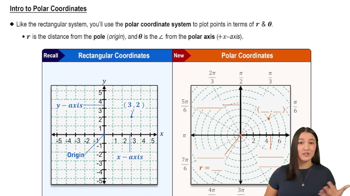
Recall that polar coordinates are given as \((r, \theta)\), where \(r\) is the radius (distance from the origin) and \(\theta\) is the angle measured from the positive x-axis.
Understand that the point described by polar coordinates \((r, \theta)\) can also be represented by \((-r, \theta + \pi)\) because moving in the opposite direction by \(\pi\) radians with a negative radius points to the same location.
Check the given coordinates: \((3, -\frac{3\pi}{4})\) and \((-3, \frac{\pi}{4})\). Notice that the second point has a negative radius and an angle \(\frac{\pi}{4}\).
Add \(\pi\) to the angle of the second point to see if it matches the first point's angle: \(\frac{\pi}{4} + \pi = \frac{5\pi}{4}\). Since \(-\frac{3\pi}{4}\) is coterminal with \(\frac{5\pi}{4}\) (they differ by \(2\pi\)), the angles correspond to the same direction.
Conclude that because \((-3, \frac{\pi}{4})\) is equivalent to \((3, \frac{5\pi}{4})\), which is coterminal with \((3, -\frac{3\pi}{4})\), both coordinates describe the same point in the plane.

비슷한 문제에 대한 검증된 영상 답변:

이 영상 해법은 위 문제에 도움이 된다고 튜터들이 추천한 것입니다.
영상 길이:
3m
도움이 되었나요?

주요 개념

질문에 올바르게 답하기 위해 반드시 이해해야 하는 핵심 개념들은 다음과 같습니다.

Polar Coordinates and Their Representation

Polar coordinates represent points in the plane using a radius and an angle, written as (r, θ). The radius r is the distance from the origin, and θ is the angle measured from the positive x-axis. Points can have multiple polar representations due to angle periodicity and sign changes in r.
추천 영상:
05:32
Intro to Polar Coordinates

Equivalence of Polar Coordinates with Negative Radius

A point with coordinates (r, θ) is equivalent to (-r, θ + π) because a negative radius means moving in the opposite direction along the line defined by θ. This property allows different pairs of (r, θ) to represent the same point by adjusting the angle by π when the radius is negative.
추천 영상:
05:32
Intro to Polar Coordinates

Angle Periodicity in Polar Coordinates

Angles in polar coordinates are periodic with period 2π, meaning θ and θ + 2kπ (for any integer k) represent the same direction. This periodicity allows angles outside the standard interval [0, 2π) or (-π, π] to still describe the same point, which is important when comparing coordinates with angles like -3π/4 and π/4.
추천 영상:
05:32
Intro to Polar Coordinates