
Ch.12 - Parametric and Polar Curves
Briggs - Calculus: Early Transcendentals 3rd Edition
Briggs3rd EditionCalculus: Early TranscendentalsISBN: 9780136847243당신이 사용하는 게 아니라요?교과서 변경
12장, 문제 12.R.62

61–64. Polar equations for conic sections Graph the following conic sections, labeling vertices, foci, directrices, and asymptotes (if they exist). Give the eccentricity of the curve. Use a graphing utility to check your work.


r = 3/(1 - 2 cos θ)

검증된 단계별 안내
1
Identify the form of the polar equation. The given equation is \(r = \frac{3}{1 - 2 \cos \theta}\), which matches the standard form for conic sections in polar coordinates: \(r = \frac{ed}{1 + e \cos \theta}\) or \(r = \frac{ed}{1 + e \sin \theta}\), where \(e\) is the eccentricity and \(d\) is the distance from the focus to the directrix.
Rewrite the equation to match the standard form \(r = \frac{ed}{1 + e \cos \theta}\). Notice the denominator is \(1 - 2 \cos \theta\), so we can write it as \(1 + (-2) \cos \theta\). This means \(e = 2\) and \(ed = 3\), so \(d = \frac{3}{e} = \frac{3}{2}\).
Determine the type of conic based on the eccentricity \(e\). Since \(e = 2 > 1\), the conic is a hyperbola.
Find the vertices by analyzing the values of \(r\) when the denominator is minimized or maximized. The vertices occur at angles where \(1 - 2 \cos \theta\) is smallest (which makes \(r\) largest) and where it is largest (which makes \(r\) smallest). Calculate \(r\) at these key angles, such as \(\theta = 0\) and \(\theta = \pi\).
Locate the focus at the pole (origin), find the directrix using \(d = \frac{3}{2}\), and sketch the asymptotes of the hyperbola based on the behavior of \(r\) as \(\theta\) approaches values that make the denominator approach zero. Label the vertices, foci, directrices, and asymptotes on the graph.

비슷한 문제에 대한 검증된 영상 답변:

이 영상 해법은 위 문제에 도움이 된다고 튜터들이 추천한 것입니다.
영상 길이:
7m
도움이 되었나요?

주요 개념

질문에 올바르게 답하기 위해 반드시 이해해야 하는 핵심 개념들은 다음과 같습니다.

Polar Form of Conic Sections

Conic sections can be represented in polar coordinates by equations of the form r = ed / (1 ± e cos θ) or r = ed / (1 ± e sin θ), where e is the eccentricity and d is the distance to the directrix. This form helps identify the type of conic (ellipse, parabola, hyperbola) based on the value of e.
추천 영상:
가이드 코스
5:33
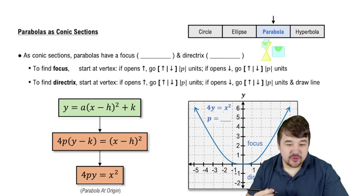
Parabolas as Conic Sections

Eccentricity and Classification of Conics

Eccentricity (e) measures how much a conic deviates from being circular: e = 0 is a circle, 0 < e < 1 is an ellipse, e = 1 is a parabola, and e > 1 is a hyperbola. Determining e from the equation allows classification and understanding of the conic's shape and properties.
추천 영상:
가이드 코스
5:33
Parabolas as Conic Sections

Graphing and Identifying Key Features

Graphing polar conics involves plotting r against θ and labeling vertices, foci, and directrices. Asymptotes appear for hyperbolas. Using a graphing utility helps visualize the curve accurately and verify key points, ensuring a complete understanding of the conic's geometry.
추천 영상:
가이드 코스
6:22
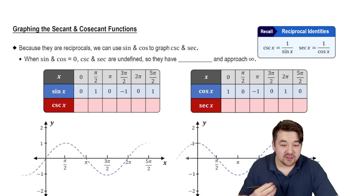
Graphs of Secant and Cosecant Functions