
Ch.12 - Parametric and Polar Curves
Briggs - Calculus: Early Transcendentals 3rd Edition
Briggs3rd EditionCalculus: Early TranscendentalsISBN: 9780136847243당신이 사용하는 게 아니라요?교과서 변경
12장, 문제 12.4.65

63–66. Tracing hyperbolas and parabolas Graph the following equations. Then use arrows and labeled points to indicate how the curve is generated as θ increases from 0 to 2π. 


r = 3/(1 - cos θ)

검증된 단계별 안내
1
Recognize that the given equation \(r = \frac{3}{1 - \cos \theta}\) is a polar equation representing a conic section. Since the denominator is of the form \(1 - e \cos \theta\) with \(e = 1\), this corresponds to a parabola in polar coordinates with the focus at the pole.
Identify the key features of the curve by analyzing the denominator \(1 - \cos \theta\). Note that when \(\cos \theta\) approaches 1, the denominator approaches zero, causing \(r\) to become very large, indicating a vertical asymptote or a direction where the curve extends to infinity.
Create a table of values for \(\theta\) at important points such as \(0\), \(\frac{\pi}{2}\), \(\pi\), \(\frac{3\pi}{2}\), and \(2\pi\). Calculate the corresponding \(r\) values (without final numeric evaluation) to understand the shape and direction of the curve at these angles.
Plot the points \((r, \theta)\) on the polar coordinate plane using the values from the table. Mark these points clearly and draw the curve smoothly through them, keeping in mind the behavior near the asymptote where \(r\) becomes very large.
Add arrows along the curve to indicate the direction of increasing \(\theta\) from \(0\) to \(2\pi\). Label key points corresponding to the angles used in the table to show how the curve is generated as \(\theta\) increases.

비슷한 문제에 대한 검증된 영상 답변:

이 영상 해법은 위 문제에 도움이 된다고 튜터들이 추천한 것입니다.
영상 길이:
3m
도움이 되었나요?

주요 개념

질문에 올바르게 답하기 위해 반드시 이해해야 하는 핵심 개념들은 다음과 같습니다.

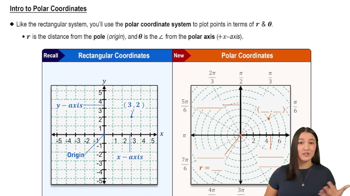
Polar Coordinates and Graphing

Polar coordinates represent points using a radius and an angle (r, θ) instead of Cartesian (x, y). Understanding how to plot points by varying θ and calculating r is essential for graphing curves like r = 3/(1 - cos θ). This system is particularly useful for curves with symmetry and periodicity.
추천 영상:
05:32
Intro to Polar Coordinates

Conic Sections in Polar Form

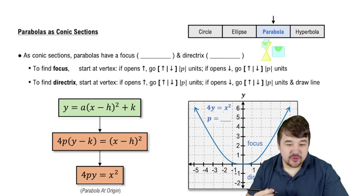
Equations like r = 3/(1 - cos θ) describe conic sections (parabolas, hyperbolas, ellipses) in polar form, where the denominator relates to the eccentricity and directrix. Recognizing this form helps identify the curve type and its geometric properties, such as focus and directrix positions.
추천 영상:
5:33
Parabolas as Conic Sections

Parametric Tracing and Direction of Curves

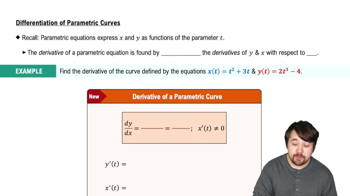
Tracing a curve as θ increases involves plotting points sequentially and using arrows to indicate direction. This helps visualize how the curve is generated over the interval 0 to 2π, showing behavior like loops or asymptotes and clarifying the curve’s orientation and shape.
추천 영상:
06:49
Differentiation of Parametric Curves