Ch. 1 - Functions
Hass - Thomas' Calculus 15th Edition
Hass15th EditionThomas' CalculusISBN: 9780137616077당신이 사용하는 게 아니라요?교과서 변경
1장, 문제 39d

Composition of Functions


In Exercises 39 and 40, find


d. (gg) (x).


ƒ(x) = 1/x , g(x) = 1/√ x + 2

검증된 단계별 안내
1
First, understand the composition of functions. The notation (g ○ g)(x) means you need to apply the function g to itself, i.e., g(g(x)).
Start by substituting g(x) into itself. Since g(x) = 1/√(x + 2), replace x in g(x) with g(x) itself.
This substitution gives you g(g(x)) = 1/√(g(x) + 2). Now, substitute g(x) = 1/√(x + 2) into this expression.
You will have g(g(x)) = 1/√((1/√(x + 2)) + 2). Simplify the expression inside the square root.
Finally, simplify the entire expression to find the composition (g ○ g)(x). Remember to handle the square roots and fractions carefully during simplification.

비슷한 문제에 대한 검증된 영상 답변:

이 영상 해법은 위 문제에 도움이 된다고 튜터들이 추천한 것입니다.
영상 길이:
2m
도움이 되었나요?

주요 개념

질문에 올바르게 답하기 위해 반드시 이해해야 하는 핵심 개념들은 다음과 같습니다.

Function Composition

Function composition involves combining two functions to create a new function. The notation (f ○ g)(x) means applying function g to x first, and then applying function f to the result of g(x). This concept is essential for understanding how to evaluate expressions like (g ○ g)(x), where the function g is applied to itself.
추천 영상:
3:48
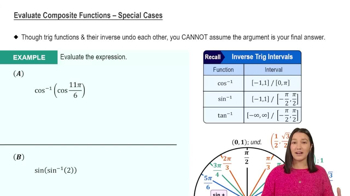
Evaluate Composite Functions - Special Cases

Domain of a Function

The domain of a function is the set of all possible input values (x-values) for which the function is defined. When composing functions, it is crucial to consider the domain of the inner function, as it can affect the overall composition. For example, in g(x) = 1/√(x + 2), the input x must be greater than or equal to -2 to avoid taking the square root of a negative number.
추천 영상:
가이드 코스
5:10
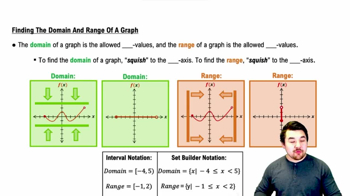
Finding the Domain and Range of a Graph

Evaluating Functions

Evaluating functions involves substituting a specific value into the function's formula to find the corresponding output. In the context of the question, evaluating (g ○ g)(x) requires first calculating g(x) and then substituting that result back into g. This step-by-step evaluation is fundamental for accurately determining the final output of the composed function.
추천 영상:
가이드 코스
4:26
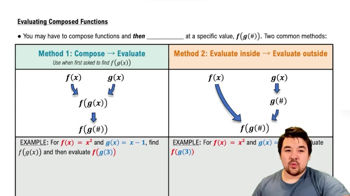
Evaluating Composed Functions