
교과서 질문
Solving Trigonometric Equations
For Exercises 51–54, solve for the angle θ, where 0 ≤ θ ≤ 2π.
sin² θ = cos² θ
293
views

 검증된 단계별 안내
 6:13
6:13
 06:21
06:21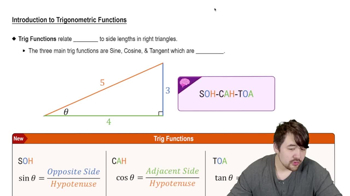 6:04
6:04Solving Trigonometric Equations
For Exercises 51–54, solve for the angle θ, where 0 ≤ θ ≤ 2π.
sin² θ = cos² θ
Increasing and Decreasing Functions
Graph the functions in Exercises 37–46. What symmetries, if any, do the graphs have? Specify the intervals over which the function is increasing and the intervals where it is decreasing.
y = −x³
Using the Addition Formulas
Use the addition formulas to derive the identities in Exercises 31–36.
sin (A − B) = sin A cos B − cos A sin B
Graph the functions in Exercises 37–56.
y = (x + 1)²/³
Shifting Graphs
Exercises 27–36 tell how many units and in what directions the graphs of the given equations are to be shifted. Give an equation for the shifted graph. Then sketch the original and shifted graphs together, labeling each graph with its equation.
y = x³ Left 1, down 1
General Sine Curves
For
f(x) = A sin ((2π/B)(x – C) +D
identify A, B, C, and D for the sine functions in Exercises 67–70 and sketch their graphs.
y = ½ sin (πx – x) + ½