Ch. 1 - Functions
Hass - Thomas' Calculus 15th Edition
Hass15th EditionThomas' CalculusISBN: 9780137616077당신이 사용하는 게 아니라요?교과서 변경
1장, 문제 1.2.43

Graph the functions in Exercises 37–56.


y = (x + 1)²/³

검증된 단계별 안내
1
Identify the type of function: The given function is y = (x + 1)^(2/3). This is a power function with a fractional exponent, which indicates a root function.
Determine the domain: Since the base of the power (x + 1) is raised to a fractional power with an even numerator, the expression is defined for all real numbers x. Therefore, the domain is all real numbers.
Find the critical points: To find critical points, take the derivative of the function with respect to x. Use the chain rule to differentiate y = (x + 1)^(2/3).
Analyze the behavior at critical points: Evaluate the derivative to find where it is zero or undefined. These points will help determine local maxima, minima, or points of inflection.
Sketch the graph: Use the information from the derivative and critical points to sketch the graph. Consider the symmetry, intercepts, and end behavior of the function to complete the graph.

비슷한 문제에 대한 검증된 영상 답변:

이 영상 해법은 위 문제에 도움이 된다고 튜터들이 추천한 것입니다.
영상 길이:
4m
도움이 되었나요?

주요 개념

질문에 올바르게 답하기 위해 반드시 이해해야 하는 핵심 개념들은 다음과 같습니다.

Graphing Functions

Graphing functions involves plotting points on a coordinate plane to visualize the behavior of a function. It requires understanding the function's domain, range, and any transformations applied to the basic function. For y = (x + 1)²/³, identifying key features like intercepts, asymptotes, and symmetry helps in sketching an accurate graph.
추천 영상:
5:53
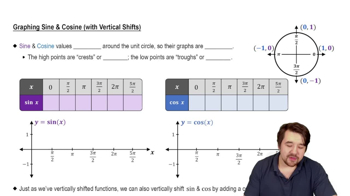
Graph of Sine and Cosine Function

Fractional Exponents

Fractional exponents, such as ²/³, indicate roots and powers. The expression (x + 1)²/³ can be interpreted as the cube root of (x + 1) squared. Understanding fractional exponents is crucial for determining the function's behavior, especially near critical points where the base might be zero or negative.
추천 영상:
가이드 코스
7:39
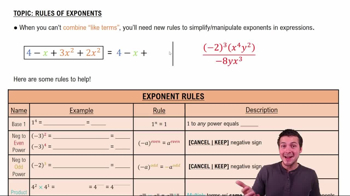
Introduction to Exponent Rules

Transformations of Functions

Transformations involve shifting, stretching, or compressing the graph of a function. The expression y = (x + 1)²/³ includes a horizontal shift left by 1 unit due to the (x + 1) term. Recognizing transformations helps in predicting how the graph will move or change shape compared to the parent function y = x²/³.
추천 영상:
5:25
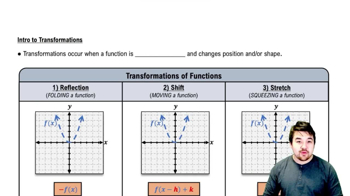
Intro to Transformations