Ch. 1 - Functions
1์žฅ, ๋ฌธ์ œ 1.P.29

In Exercises 19โ€“32, find the (a) domain and (b) range.
________
๐”‚ = 5 - โˆš xยฒ - 2x - 3

๊ฒ€์ฆ๋œ ๋‹จ๊ณ„๋ณ„ ์•ˆ๋‚ด
1
Step 1: Identify the expression under the square root, which is \( x^2 - 2x - 3 \). For the square root to be defined, this expression must be greater than or equal to zero. Set up the inequality \( x^2 - 2x - 3 \geq 0 \).
Step 2: Solve the inequality \( x^2 - 2x - 3 \geq 0 \). First, find the roots of the equation \( x^2 - 2x - 3 = 0 \) by factoring or using the quadratic formula. The factored form is \( (x - 3)(x + 1) = 0 \), giving roots \( x = 3 \) and \( x = -1 \).
Step 3: Determine the intervals where \( x^2 - 2x - 3 \geq 0 \) by testing intervals around the roots. The intervals to test are \( (-\infty, -1) \), \( (-1, 3) \), and \( (3, \infty) \).
Step 4: Analyze the sign of \( x^2 - 2x - 3 \) in each interval. For \( x < -1 \) and \( x > 3 \), the expression is positive, and for \( -1 < x < 3 \), it is negative. Thus, the domain of \( y \) is \( (-\infty, -1] \cup [3, \infty) \).
Step 5: Determine the range of \( y = 5 - \sqrt{x^2 - 2x - 3} \). Since the square root function outputs non-negative values, the maximum value of \( \sqrt{x^2 - 2x - 3} \) is 0, which occurs at the endpoints of the domain. Therefore, the range of \( y \) is \( (-\infty, 5] \).

๋น„์Šทํ•œ ๋ฌธ์ œ์— ๋Œ€ํ•œ ๊ฒ€์ฆ๋œ ์˜์ƒ ๋‹ต๋ณ€:

์ด ์˜์ƒ ํ•ด๋ฒ•์€ ์œ„ ๋ฌธ์ œ์— ๋„์›€์ด ๋œ๋‹ค๊ณ  ํŠœํ„ฐ๋“ค์ด ์ถ”์ฒœํ•œ ๊ฒƒ์ž…๋‹ˆ๋‹ค.
์˜์ƒ ๊ธธ์ด:
5m
๋„์›€์ด ๋˜์—ˆ๋‚˜์š”?

์ฃผ์š” ๊ฐœ๋…

์งˆ๋ฌธ์— ์˜ฌ๋ฐ”๋ฅด๊ฒŒ ๋‹ตํ•˜๊ธฐ ์œ„ํ•ด ๋ฐ˜๋“œ์‹œ ์ดํ•ดํ•ด์•ผ ํ•˜๋Š” ํ•ต์‹ฌ ๊ฐœ๋…๋“ค์€ ๋‹ค์Œ๊ณผ ๊ฐ™์Šต๋‹ˆ๋‹ค.

Domain of a Function

The domain of a function refers to the set of all possible input values (x-values) for which the function is defined. For functions involving square roots, the expression inside the square root must be non-negative. Thus, determining the domain often involves solving inequalities to find the valid range of x-values.
์ถ”์ฒœ ์˜์ƒ:
5:10
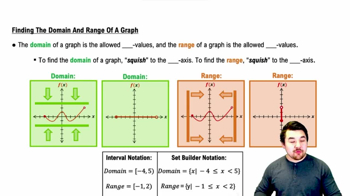
Finding the Domain and Range of a Graph

Range of a Function

The range of a function is the set of all possible output values (y-values) that the function can produce. To find the range, one must analyze the behavior of the function, particularly its maximum and minimum values, and consider any restrictions imposed by the function's formula.
์ถ”์ฒœ ์˜์ƒ:
5:10
Finding the Domain and Range of a Graph

Quadratic Expressions

Quadratic expressions are polynomials of degree two, typically in the form axยฒ + bx + c. In the context of the given function, simplifying the expression under the square root, which is a quadratic, is essential for determining both the domain and range. Understanding how to factor or complete the square can aid in this analysis.
์ถ”์ฒœ ์˜์ƒ:
6:36
Simplifying Trig Expressions