Ch. 1 - Functions
1์žฅ, ๋ฌธ์ œ 1.P.30

In Exercises 19โ€“32, find the (a) domain and (b) range.


๐”‚ = 2 + 3xยฒ .
xยฒ + 4

๊ฒ€์ฆ๋œ ๋‹จ๊ณ„๋ณ„ ์•ˆ๋‚ด
1
Step 1: Identify the function given, which is \( y = \frac{2 + 3x^2}{x^2 + 4} \). This is a rational function, where the numerator is \( 2 + 3x^2 \) and the denominator is \( x^2 + 4 \).
Step 2: Determine the domain of the function. For rational functions, the domain is all real numbers except where the denominator is zero. Since \( x^2 + 4 \) is always positive for all real numbers (as \( x^2 \) is non-negative and 4 is positive), the denominator is never zero. Therefore, the domain is all real numbers, \( (-\infty, \infty) \).
Step 3: To find the range, analyze the behavior of the function as \( x \) approaches positive and negative infinity. As \( x \to \infty \) or \( x \to -\infty \), the dominant terms in the numerator and denominator are \( 3x^2 \) and \( x^2 \), respectively. Thus, the function approaches \( \frac{3x^2}{x^2} = 3 \).
Step 4: Consider the horizontal asymptote. Since the degrees of the numerator and denominator are the same, the horizontal asymptote is the ratio of the leading coefficients, which is \( y = 3 \). This suggests that the function approaches 3 but never actually reaches it.
Step 5: Evaluate the function at specific points to understand its behavior further. For example, calculate \( y \) at \( x = 0 \) to find \( y = \frac{2 + 3(0)^2}{0^2 + 4} = \frac{2}{4} = \frac{1}{2} \). This helps confirm that the range includes values below 3. Therefore, the range is \( (-\infty, 3) \).

๋น„์Šทํ•œ ๋ฌธ์ œ์— ๋Œ€ํ•œ ๊ฒ€์ฆ๋œ ์˜์ƒ ๋‹ต๋ณ€:

์ด ์˜์ƒ ํ•ด๋ฒ•์€ ์œ„ ๋ฌธ์ œ์— ๋„์›€์ด ๋œ๋‹ค๊ณ  ํŠœํ„ฐ๋“ค์ด ์ถ”์ฒœํ•œ ๊ฒƒ์ž…๋‹ˆ๋‹ค.
์˜์ƒ ๊ธธ์ด:
5m
๋„์›€์ด ๋˜์—ˆ๋‚˜์š”?

์ฃผ์š” ๊ฐœ๋…

์งˆ๋ฌธ์— ์˜ฌ๋ฐ”๋ฅด๊ฒŒ ๋‹ตํ•˜๊ธฐ ์œ„ํ•ด ๋ฐ˜๋“œ์‹œ ์ดํ•ดํ•ด์•ผ ํ•˜๋Š” ํ•ต์‹ฌ ๊ฐœ๋…๋“ค์€ ๋‹ค์Œ๊ณผ ๊ฐ™์Šต๋‹ˆ๋‹ค.

Domain of a Function

The domain of a function refers to the set of all possible input values (x-values) for which the function is defined. For rational functions, like y = (2 + 3xยฒ) / (xยฒ + 4), the domain excludes values that make the denominator zero. In this case, since xยฒ + 4 is always positive, the domain is all real numbers.
์ถ”์ฒœ ์˜์ƒ:
5:10
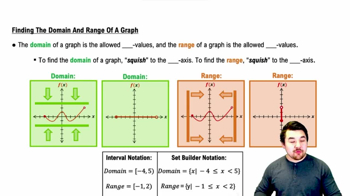
Finding the Domain and Range of a Graph

Range of a Function

The range of a function is the set of all possible output values (y-values) that the function can produce. To find the range, analyze the behavior of the function as x approaches various values, including infinity. For y = (2 + 3xยฒ) / (xยฒ + 4), consider the limits and behavior of the function to determine the range.
์ถ”์ฒœ ์˜์ƒ:
5:10
Finding the Domain and Range of a Graph

Behavior of Rational Functions

Understanding the behavior of rational functions involves analyzing how the function behaves as x approaches infinity or negative infinity, and identifying any asymptotes. For y = (2 + 3xยฒ) / (xยฒ + 4), as x becomes very large, the function approaches a horizontal asymptote, which helps in determining the range.
์ถ”์ฒœ ์˜์ƒ:
6:04
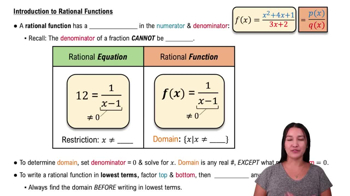
Intro to Rational Functions