

Ch. 1 - Functions
Hass - Thomas' Calculus 15th Edition
Hass15th EditionThomas' CalculusISBN: 9780137616077당신이 사용하는 게 아니라요?교과서 변경
1장, 문제 65

In Exercises 65–68, ABC is a right triangle with the right angle at C. The sides opposite angles A, B, and C are a, b, and c, respectively.


a. Find a and b if c = 2, B = π/3.
b. Find a and c if b = 2, B = π/3.

검증된 단계별 안내
1
To solve part (a), we start by using the given information: c = 2 and angle B = π/3. Since ABC is a right triangle, we can use trigonometric ratios. The side opposite angle B is b, and the hypotenuse is c.
Use the sine function for angle B: sin(B) = opposite/hypotenuse = b/c. Substitute the known values: sin(π/3) = b/2. Solve for b using the fact that sin(π/3) = √3/2.
Next, use the cosine function for angle B: cos(B) = adjacent/hypotenuse = a/c. Substitute the known values: cos(π/3) = a/2. Solve for a using the fact that cos(π/3) = 1/2.
For part (b), we are given b = 2 and angle B = π/3. We need to find a and c. Use the tangent function for angle B: tan(B) = opposite/adjacent = b/a. Substitute the known values: tan(π/3) = 2/a. Solve for a using the fact that tan(π/3) = √3.
Finally, use the Pythagorean theorem to find c: a² + b² = c². Substitute the known values for a and b to solve for c.

비슷한 문제에 대한 검증된 영상 답변:

이 영상 해법은 위 문제에 도움이 된다고 튜터들이 추천한 것입니다.
영상 길이:
4m
도움이 되었나요?

주요 개념

질문에 올바르게 답하기 위해 반드시 이해해야 하는 핵심 개념들은 다음과 같습니다.

Pythagorean Theorem

The Pythagorean Theorem states that in a right triangle, the square of the length of the hypotenuse (c) is equal to the sum of the squares of the lengths of the other two sides (a and b). This relationship is expressed as a² + b² = c², and is fundamental for solving problems involving right triangles.
추천 영상:
06:11
Fundamental Theorem of Calculus Part 1

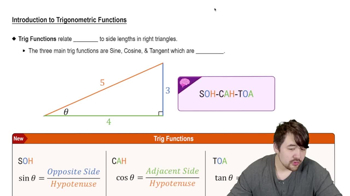
Trigonometric Ratios

Trigonometric ratios relate the angles of a triangle to the lengths of its sides. For a right triangle, the sine, cosine, and tangent functions are defined as sin(B) = opposite/hypotenuse, cos(B) = adjacent/hypotenuse, and tan(B) = opposite/adjacent. These ratios are essential for finding unknown side lengths when angles are known.
추천 영상:
6:04
Introduction to Trigonometric Functions

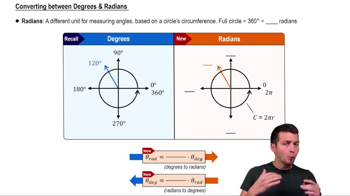
Angle Measures in Radians

In calculus and trigonometry, angles can be measured in degrees or radians. Radians are a more natural measure for angles in mathematical analysis, where π radians correspond to 180 degrees. Understanding how to convert between these two systems is crucial for applying trigonometric functions correctly in problems involving angles.
추천 영상:
가이드 코스
5:04
Converting between Degrees & Radians