Ch. 1 - Functions
Hass - Thomas' Calculus 15th Edition
Hass15th EditionThomas' CalculusISBN: 9780137616077당신이 사용하는 게 아니라요?교과서 변경
1장, 문제 1.1.72

[Technology Exercise]


a. Graph the functions f(x) = 3/(x − 1) and g(x) = 2/(x + 1) together to identify the values of x for which


3/(x − 1) < 2/(x + 1)


b. Confirm your findings in part (a) algebraically.

검증된 단계별 안내
1
Step 1: To graph the functions f(x) = 3/(x - 1) and g(x) = 2/(x + 1), first identify their vertical asymptotes. For f(x), the vertical asymptote is at x = 1, and for g(x), it is at x = -1. These are the values where the functions are undefined.
Step 2: Plot the graphs of both functions on the same coordinate plane. Notice that both functions are hyperbolas, and observe their behavior as x approaches the asymptotes and as x goes to positive or negative infinity.
Step 3: To find the values of x for which 3/(x - 1) < 2/(x + 1), look for the regions where the graph of f(x) is below the graph of g(x). This will give a visual indication of the solution to the inequality.
Step 4: To confirm algebraically, set up the inequality 3/(x - 1) < 2/(x + 1). Cross-multiply to eliminate the fractions, resulting in 3(x + 1) < 2(x - 1).
Step 5: Simplify the inequality from Step 4 to find the range of x values that satisfy it. This involves expanding both sides, combining like terms, and solving for x. Be sure to consider the domain restrictions due to the asymptotes.

비슷한 문제에 대한 검증된 영상 답변:

이 영상 해법은 위 문제에 도움이 된다고 튜터들이 추천한 것입니다.
영상 길이:
11m
도움이 되었나요?

주요 개념

질문에 올바르게 답하기 위해 반드시 이해해야 하는 핵심 개념들은 다음과 같습니다.

Graphing Rational Functions

Graphing rational functions involves plotting functions that are ratios of polynomials. Key features to consider include vertical asymptotes, which occur where the denominator is zero, and horizontal asymptotes, which describe the end behavior of the function. For f(x) = 3/(x − 1) and g(x) = 2/(x + 1), vertical asymptotes are at x = 1 and x = -1, respectively.
추천 영상:
5:53
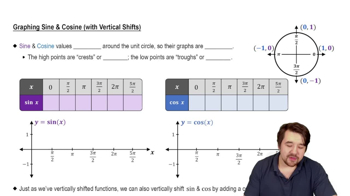
Graph of Sine and Cosine Function

Inequalities of Rational Functions

To solve inequalities involving rational functions, such as 3/(x − 1) < 2/(x + 1), one must determine where one function is less than the other. This involves finding critical points where the functions intersect or where the inequality changes sign, often requiring a combination of graphing and algebraic manipulation to identify solution intervals.
추천 영상:
6:04
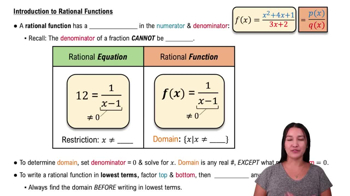
Intro to Rational Functions

Algebraic Confirmation of Inequalities

Confirming inequalities algebraically involves manipulating the inequality to isolate terms and solve for x. For rational functions, this often requires finding a common denominator, simplifying the inequality, and testing intervals between critical points. This process verifies the graphical solution by ensuring the inequality holds true across the identified intervals.
추천 영상:
05:25
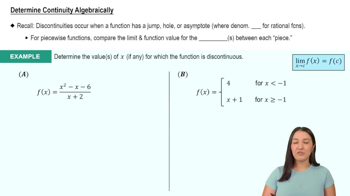
Determine Continuity Algebraically