Ch. 10 - Infinite Sequences and Series
Hass - Thomas' Calculus 15th Edition
Hass15th EditionThomas' CalculusISBN: 9780137616077당신이 사용하는 게 아니라요?교과서 변경
10장, 문제 10.5.60

Convergence or Divergence
Which of the series in Exercises 57–64 converge, and which diverge? Give reasons for your answers.
∑ (from n = 1 to ∞) [(-1)ⁿ (n!)ⁿ] / [n^(n²)]

검증된 단계별 안내
1
Identify the given series: \( \sum_{n=1}^{\infty} \frac{(-1)^n (n!)^n}{n^{n^2}} \). We want to determine whether this series converges or diverges.
Since the series involves factorials and powers raised to powers, consider using the Root Test, which is effective for series with terms raised to the \( n \)-th power. The Root Test uses the limit \( L = \lim_{n \to \infty} \sqrt[n]{|a_n|} \), where \( a_n = \frac{(-1)^n (n!)^n}{n^{n^2}} \).
Calculate \( \sqrt[n]{|a_n|} = \sqrt[n]{\frac{(n!)^n}{n^{n^2}}} = \frac{n!}{n^{n}} \) because \( \sqrt[n]{(n!)^n} = n! \) and \( \sqrt[n]{n^{n^2}} = n^{n} \).
Analyze the behavior of \( \frac{n!}{n^n} \) as \( n \to \infty \). Use Stirling's approximation for factorials: \( n! \approx \sqrt{2 \pi n} \left( \frac{n}{e} \right)^n \). Substitute this approximation to understand the limit.
Evaluate the limit \( L = \lim_{n \to \infty} \frac{n!}{n^n} \approx \lim_{n \to \infty} \frac{\sqrt{2 \pi n} \left( \frac{n}{e} \right)^n}{n^n} = \lim_{n \to \infty} \sqrt{2 \pi n} \left( \frac{1}{e} \right)^n \). Since \( \left( \frac{1}{e} \right)^n \) tends to zero exponentially, \( L = 0 \). According to the Root Test, if \( L < 1 \), the series converges absolutely.

비슷한 문제에 대한 검증된 영상 답변:

이 영상 해법은 위 문제에 도움이 된다고 튜터들이 추천한 것입니다.
영상 길이:
4m

주요 개념

질문에 올바르게 답하기 위해 반드시 이해해야 하는 핵심 개념들은 다음과 같습니다.

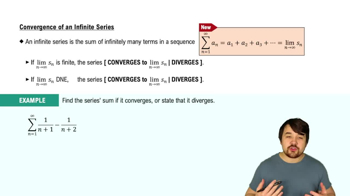
Convergence and Divergence of Infinite Series

An infinite series converges if the sum of its terms approaches a finite limit as the number of terms grows indefinitely; otherwise, it diverges. Determining convergence involves analyzing the behavior of the terms and applying appropriate tests to assess whether the series sums to a finite value.
추천 영상:
가이드 코스
06:52
Convergence of an Infinite Series

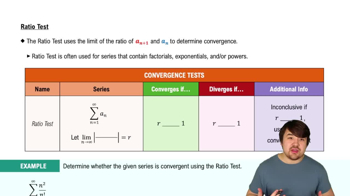
Ratio Test

The Ratio Test evaluates the limit of the absolute value of the ratio of consecutive terms in a series. If this limit is less than 1, the series converges absolutely; if greater than 1, it diverges; if equal to 1, the test is inconclusive. This test is especially useful for series involving factorials and exponential terms.
추천 영상:

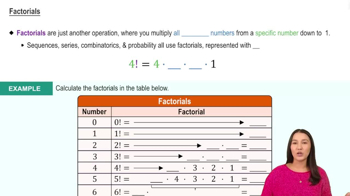
Factorials and Exponential Growth

Factorials (n!) grow faster than exponential functions as n increases, which significantly affects the behavior of series terms. Understanding how factorials compare to powers and exponentials helps in applying convergence tests and predicting whether terms shrink quickly enough for the series to converge.
추천 영상:
5:22
Factorials