Estimate the value of ∑ (from n=2 to ∞) (1 / (n² + 4)) to within 0.1 of its exact value.
Ch. 10 - Infinite Sequences and Series
10장, 문제 10.2.1
Finding nth Partial Sums
In Exercises 1–6, find a formula for the nth partial sum of each series and use it to find the series’ sum if the series converges.
2 + (2/3) + (2/9) + (2/27) + … + (2 / 3ⁿ⁻¹) + …
검증된 단계별 안내1
Identify the type of series given. Notice that the series is 2 + \(\frac{2}{3}\) + \(\frac{2}{9}\) + \(\frac{2}{27}\) + \(\dots\), which is a geometric series where each term is multiplied by \(\frac{1}{3}\) to get the next term.
Write the general term of the series. The first term a is 2, and the common ratio r is \(\frac{1}{3}\). So, the nth term can be expressed as a_n = 2 \(\times\) \(\left\)(\(\frac{1}{3}\)\(\right\))^{n-1}.
Use the formula for the nth partial sum of a geometric series: S_n = a \(\times\) \(\frac{1 - r^n}{1 - r}\). Substitute a = 2 and r = \(\frac{1}{3}\) into this formula to get S_n.
Simplify the expression for S_n by plugging in the values and rewriting the formula clearly: S_n = 2 \(\times\) \(\frac{1 - \left(\frac{1}{3}\)\(\right\))^n}{1 - \(\frac{1}{3}\)}.
Determine if the series converges by examining the limit of S_n as n approaches infinity. Since |r| = \(\frac{1}{3}\) < 1, the series converges, and the sum to infinity is S = \(\frac{a}{1 - r}\).

비슷한 문제에 대한 검증된 영상 답변:
이 영상 해법은 위 문제에 도움이 된다고 튜터들이 추천한 것입니다.
영상 길이:
3m도움이 되었나요?
주요 개념
질문에 올바르게 답하기 위해 반드시 이해해야 하는 핵심 개념들은 다음과 같습니다.
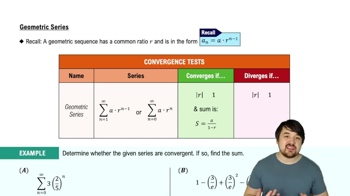
Geometric Series
A geometric series is a sum of terms where each term is found by multiplying the previous term by a constant ratio. In this problem, the series has a common ratio of 1/3, making it geometric. Understanding this helps in finding a general formula for the nth partial sum.
추천 영상:
가이드 코스
Geometric Series
Nth Partial Sum Formula
The nth partial sum of a geometric series is given by S_n = a(1 - r^n) / (1 - r), where a is the first term and r is the common ratio. This formula allows calculation of the sum of the first n terms, which is essential for analyzing convergence and total sums.
추천 영상:
가이드 코스
Integration Using Partial Fractions
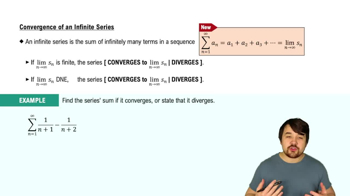
Convergence of Infinite Series
An infinite geometric series converges if the absolute value of the common ratio is less than 1. When it converges, the sum approaches S = a / (1 - r) as n approaches infinity. Recognizing convergence is key to determining the series’ total sum.
추천 영상:
가이드 코스
Convergence of an Infinite Series
관련 실천
교과서 질문
25
views
교과서 질문
Determining Convergence or Divergence
Which of the series in Exercises 17–56 converge, and which diverge? Use any method, and give reasons for your answers.
∑ (from n=1 to ∞) sin (1/n)
29
views
교과서 질문
Recursively Defined Sequences
In Exercises 101–108, assume that each sequence converges and find its limit.
a₁ = 5,aₙ₊₁ = √(5aₙ)
27
views
교과서 질문
In Exercises 37–42, find the series’ radius of convergence.
∑ (from n = 1 to ∞) [ (n!)² / (2ⁿ (2n)!) ] xⁿ
5
views
교과서 질문
Finding a Sequence’s Formula
In Exercises 13–30, find a formula for the nth term of the sequence.
2, 6, 10, 14, 18, …Every other even positive integer
28
views
교과서 질문
Use power series operations to find the Taylor series at x = 0 for the functions in Exercises 13–30.
sin x – x + (x³ / 3!)
49
views