Ch. 10 - Infinite Sequences and Series
Hass - Thomas' Calculus 15th Edition
Hass15th EditionThomas' CalculusISBN: 9780137616077당신이 사용하는 게 아니라요?교과서 변경
10장, 문제 10.3.56

Estimate the value of ∑ (from n=2 to ∞) (1 / (n² + 4)) to within 0.1 of its exact value.

검증된 단계별 안내
1
Recognize that the series \( \sum_{n=2}^{\infty} \frac{1}{n^2 + 4} \) is a positive, decreasing series, which allows us to use the Integral Test or comparison tests to estimate the remainder (error) when approximating the infinite sum by a partial sum.
Calculate the partial sum \( S_N = \sum_{n=2}^{N} \frac{1}{n^2 + 4} \) for some finite \( N \). This partial sum will serve as an approximation to the infinite series.
Estimate the remainder \( R_N = \sum_{n=N+1}^{\infty} \frac{1}{n^2 + 4} \) to understand how close \( S_N \) is to the exact value. Since \( \frac{1}{n^2 + 4} < \frac{1}{n^2} \), you can use the integral test remainder estimate or compare with the integral \( \int_{N}^{\infty} \frac{1}{x^2} \, dx \) to bound the error.
Use the integral \( \int_{N}^{\infty} \frac{1}{x^2} \, dx = \frac{1}{N} \) as an upper bound for the remainder \( R_N \), which means \( R_N < \frac{1}{N} \). Choose \( N \) such that \( \frac{1}{N} < 0.1 \) to ensure the approximation is within 0.1 of the exact value.
Sum the terms up to this \( N \) to get \( S_N \), and state that \( S_N \) approximates the infinite sum \( \sum_{n=2}^{\infty} \frac{1}{n^2 + 4} \) with an error less than 0.1.

비슷한 문제에 대한 검증된 영상 답변:

이 영상 해법은 위 문제에 도움이 된다고 튜터들이 추천한 것입니다.
영상 길이:
11m

주요 개념

질문에 올바르게 답하기 위해 반드시 이해해야 하는 핵심 개념들은 다음과 같습니다.

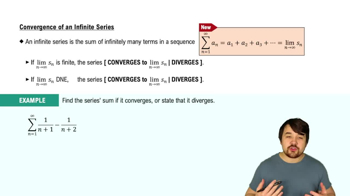
Infinite Series and Convergence

An infinite series is the sum of infinitely many terms. Understanding whether the series converges (approaches a finite value) is essential before estimating its sum. For series with positive decreasing terms, convergence can often be tested using comparison or integral tests.
추천 영상:
가이드 코스
06:52
Convergence of an Infinite Series

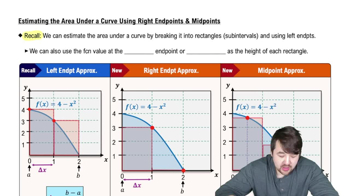
Partial Sums and Remainder Estimation

Partial sums add a finite number of terms from the series to approximate the total sum. The remainder (or tail) is the difference between the infinite sum and the partial sum. Estimating this remainder helps determine how close the partial sum is to the exact value.
추천 영상:
가이드 코스
05:59
Estimating the Area Under a Curve with Right Endpoints & Midpoint

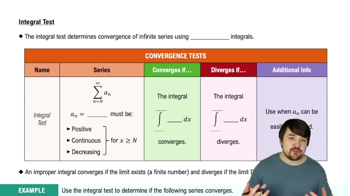
Integral Test for Remainder Bounds

The integral test compares a series to an improper integral to assess convergence and estimate the remainder. For a decreasing positive function f(n), the remainder after N terms is bounded by integrals of f(x) from N to infinity, providing a way to estimate the error in partial sums.
추천 영상: