Ch. 10 - Infinite Sequences and Series
Hass - Thomas' Calculus 15th Edition
Hass15th EditionThomas' CalculusISBN: 9780137616077당신이 사용하는 게 아니라요?교과서 변경
10장, 문제 10.8.18

Finding Taylor Series at x = 0 (Maclaurin Series)
Find the Maclaurin series for the functions in Exercises 11–24.
5 cos πx

검증된 단계별 안내
1
Recall that the Maclaurin series is the Taylor series expansion of a function at \(x = 0\), given by the formula: \[f(x) = \sum_{n=0}^{\infty} \frac{f^{(n)}(0)}{n!} x^n,\] where \(f^{(n)}(0)\) is the \(n\)-th derivative of \(f\) evaluated at 0.
Identify the base function inside the given function. Here, the function is \(f(x) = 5 \cos(\pi x)\). We can factor out the constant 5 and focus on the Maclaurin series for \(\cos(\pi x)\).
Recall the Maclaurin series for \(\cos u\) is \[\cos u = \sum_{n=0}^{\infty} (-1)^n \frac{u^{2n}}{(2n)!}.\] In this problem, substitute \(u = \pi x\) to get \[\cos(\pi x) = \sum_{n=0}^{\infty} (-1)^n \frac{(\pi x)^{2n}}{(2n)!}.\]
Multiply the entire series by 5 to account for the coefficient in the original function: \[5 \cos(\pi x) = 5 \sum_{n=0}^{\infty} (-1)^n \frac{(\pi x)^{2n}}{(2n)!} = \sum_{n=0}^{\infty} 5 (-1)^n \frac{\pi^{2n} x^{2n}}{(2n)!}.\]
Write out the first few terms explicitly by plugging in \(n=0,1,2,\ldots\) to see the pattern of the series, which helps in understanding the expansion and verifying correctness.

비슷한 문제에 대한 검증된 영상 답변:

이 영상 해법은 위 문제에 도움이 된다고 튜터들이 추천한 것입니다.
영상 길이:
1m

주요 개념

질문에 올바르게 답하기 위해 반드시 이해해야 하는 핵심 개념들은 다음과 같습니다.

Maclaurin Series

A Maclaurin series is a special case of the Taylor series expanded at x = 0. It represents a function as an infinite sum of its derivatives evaluated at zero, multiplied by powers of x and divided by factorial terms. This series helps approximate functions near zero.
추천 영상:
08:26
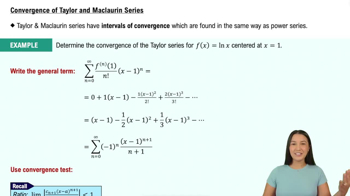
Convergence of Taylor & Maclaurin Series

Derivatives of Trigonometric Functions

To find the Maclaurin series of 5 cos(πx), you need to compute derivatives of cos(πx) at x = 0. The derivatives cycle every four steps due to the periodic nature of cosine and sine, and each derivative involves the chain rule because of the inner function πx.
추천 영상:
06:35
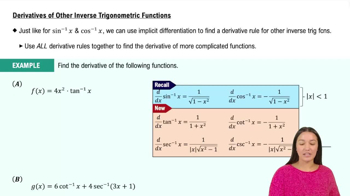
Derivatives of Other Inverse Trigonometric Functions

Chain Rule in Differentiation

The chain rule is used to differentiate composite functions like cos(πx). It states that the derivative of f(g(x)) is f'(g(x)) times g'(x). Applying this rule correctly is essential to find the derivatives needed for the Maclaurin series coefficients.
추천 영상:
05:02
Intro to the Chain Rule