Ch. 10 - Infinite Sequences and Series
Hass - Thomas' Calculus 15th Edition
Hass15th EditionThomas' CalculusISBN: 9780137616077당신이 사용하는 게 아니라요?교과서 변경
10장, 문제 10.7.58a

The series
eˣ = 1 + x + x²/2! + x³/3! + x⁴/4! + x⁵/5! + ⋯
converges to eˣ for all x.
a. Find a series for (d/dx)eˣ. Do you get the series for eˣ? Explain your answer.

검증된 단계별 안내
1
Recall the given series expansion for \(e^x\): \[e^x = 1 + x + \frac{x^2}{2!} + \frac{x^3}{3!} + \frac{x^4}{4!} + \frac{x^5}{5!} + \cdots\]
To find the series for \(\frac{d}{dx} e^x\), differentiate the series term-by-term. Use the power rule for differentiation: \[\frac{d}{dx} x^n = n x^{n-1}\]
Apply the derivative to each term: - The derivative of the constant term \(1\) is \(0\). - The derivative of \(x\) is \(1\). - The derivative of \(\frac{x^2}{2!}\) is \(\frac{2 x^{1}}{2!}\). - The derivative of \(\frac{x^3}{3!}\) is \(\frac{3 x^{2}}{3!}\). - Continue similarly for higher powers.
Simplify each term after differentiation: For example, \(\frac{2 x^{1}}{2!} = \frac{2 x}{2} = x\), and \(\frac{3 x^{2}}{3!} = \frac{3 x^{2}}{6} = \frac{x^{2}}{2}\), and so on.
After simplifying, observe the resulting series and compare it to the original series for \(e^x\). Explain whether the differentiated series matches the original series and why this confirms the property that the derivative of \(e^x\) is \(e^x\).

비슷한 문제에 대한 검증된 영상 답변:

이 영상 해법은 위 문제에 도움이 된다고 튜터들이 추천한 것입니다.
영상 길이:
2m

주요 개념

질문에 올바르게 답하기 위해 반드시 이해해야 하는 핵심 개념들은 다음과 같습니다.

Power Series Representation

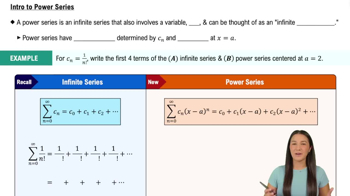
A power series expresses a function as an infinite sum of terms involving powers of a variable, often centered at zero. For example, eˣ can be written as the sum of xⁿ/n! for n from 0 to infinity. Understanding this allows us to manipulate and differentiate functions term-by-term.
추천 영상:
05:58
Intro to Power Series

Term-by-Term Differentiation of Power Series

If a power series converges within an interval, it can be differentiated term-by-term within that interval. Differentiating each term xⁿ/n! yields n*xⁿ⁻¹/n! = xⁿ⁻¹/(n-1)!, which reconstructs the original series shifted by one index, showing the derivative series corresponds to the original function.
추천 영상:
05:58
Intro to Power Series

Derivative of the Exponential Function

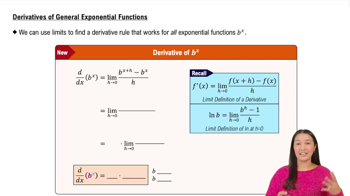
The exponential function eˣ is unique because its derivative is itself, meaning d/dx(eˣ) = eˣ. This property is reflected in its power series, where differentiating term-by-term reproduces the same series, confirming the function’s self-derivative nature.
추천 영상:
04:50
Derivatives of General Exponential Functions
관련 실천
교과서 질문

∑ (from n=1 to ∞) (1 / √(n + 1)) diverges

b. What should n be in order that the partial sum sₙ = ∑ (from i=1 to n) (1 / √(i + 1)) satisfies sₙ > 1000?

29
views

교과서 질문

A sequence of rational numbers is described as follows:

1/1,3/2,7/5,17/12,…,a/b,(a + 2b)/(a + b),…

Here the numerators form one sequence, the denominators form a second sequence, and their ratios form a third sequence. Let xₙ and yₙ be, respectively, the numerator and the denominator of the nᵗʰ fraction rₙ = xₙ / yₙ.

b. The fractions rₙ = xₙ / yₙ approach a limit as n increases. What is that limit? (Hint: Use part (a) to show that rₙ² − 2 = ±(1 / yₙ)² and that yₙ is not less than n.)

33
views
교과서 질문

Quadratic Approximations The Taylor polynomial of order 2 generated by a twice-differentiable function f(x) at x = a is called the quadratic approximation of f at x = a. In Exercises 41–46, find the (a) linearization (Taylor polynomial of order 1)

f(x) = ln(cos x)

26
views
교과서 질문

Quadratic Approximations The Taylor polynomial of order 2 generated by a twice-differentiable function f(x) at x = a is called the quadratic approximation of f at x = a. In Exercises 41–46, find the (a) linearization (Taylor polynomial of order 1)

f(x) = 1 / √(1 − x²)

24
views
교과서 질문

Intervals of Convergence

In Exercises 1–36, (a) find the series’ radius and interval of convergence.

∑ (from n = 1 to ∞) [ (√(n + 1) − √n)(x − 3)ⁿ ]

31
views
교과서 질문

Intervals of Convergence

In Exercises 1–36, for what values of x does the series converge (b) absolutely?

∑ (from n = 0 to ∞) [ (−2)ⁿ (n + 1) (x − 1)ⁿ ]

23
views