Ch. 10 - Infinite Sequences and Series
Hass - Thomas' Calculus 15th Edition
Hass15th EditionThomas' CalculusISBN: 9780137616077당신이 사용하는 게 아니라요?교과서 변경
10장, 문제 10.3.53b

∑ (from n=1 to ∞) (1 / √(n + 1)) diverges
b. What should n be in order that the partial sum sₙ = ∑ (from i=1 to n) (1 / √(i + 1)) satisfies sₙ > 1000?

검증된 단계별 안내
1
Recognize that the series \( \sum_{n=1}^{\infty} \frac{1}{\sqrt{n+1}} \) diverges, meaning its partial sums grow without bound as \( n \to \infty \). Therefore, for any large number like 1000, there exists some \( n \) such that the partial sum \( s_n = \sum_{i=1}^n \frac{1}{\sqrt{i+1}} \) exceeds 1000.
To estimate the value of \( n \) for which \( s_n > 1000 \), use the integral test approximation. Since \( f(x) = \frac{1}{\sqrt{x+1}} \) is positive and decreasing for \( x \geq 1 \), the sum \( s_n \) can be approximated by the integral \( \int_1^{n} \frac{1}{\sqrt{x+1}} \, dx \).
Set up the integral \( I = \int_1^{n} \frac{1}{\sqrt{x+1}} \, dx \). To solve this integral, perform the substitution \( u = x + 1 \), so \( du = dx \), and the limits change from \( x=1 \) to \( u=2 \), and \( x=n \) to \( u = n+1 \). The integral becomes \( \int_2^{n+1} u^{-1/2} \, du \).
Evaluate the integral \( \int_2^{n+1} u^{-1/2} \, du = 2(\sqrt{n+1} - \sqrt{2}) \). This gives an approximation for the partial sum \( s_n \) as \( s_n \approx 2(\sqrt{n+1} - \sqrt{2}) \).
Set the inequality \( 2(\sqrt{n+1} - \sqrt{2}) > 1000 \) to find the smallest \( n \) such that the partial sum exceeds 1000. Solve this inequality for \( n \) by isolating \( \sqrt{n+1} \) and then squaring both sides to find \( n \).

비슷한 문제에 대한 검증된 영상 답변:

이 영상 해법은 위 문제에 도움이 된다고 튜터들이 추천한 것입니다.
영상 길이:
6m
도움이 되었나요?

주요 개념

질문에 올바르게 답하기 위해 반드시 이해해야 하는 핵심 개념들은 다음과 같습니다.

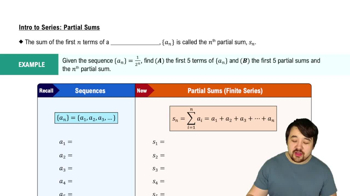
Infinite Series and Partial Sums

An infinite series is the sum of infinitely many terms, and its partial sums are the sums of the first n terms. Understanding how partial sums behave helps determine how large n must be for the sum to exceed a certain value, even if the series diverges.
추천 영상:
가이드 코스
06:45
Intro to Series: Partial Sums

Divergence of a Series

A series diverges if its partial sums do not approach a finite limit as n approaches infinity. The given series ∑ 1/√(n+1) diverges because its terms decrease too slowly, meaning the sum grows without bound, which is crucial for knowing that sₙ can exceed any finite number.
추천 영상:
가이드 코스
06:00
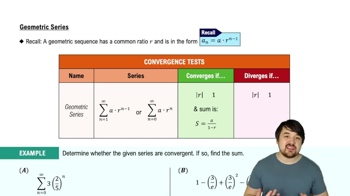
Geometric Series

Integral Test for Series Estimation

The integral test compares a series to an improper integral to estimate the size of partial sums. For decreasing positive terms like 1/√(n+1), the integral of 1/√x from 1 to n approximates the partial sum, helping to find n such that sₙ > 1000.
추천 영상:
가이드 코스
10:54
Alternating Series Test
관련 실천
교과서 질문

b. From Example 5, Section 10.2, show that

S = 1 + ∑(from n=1 to ∞) [1 / (n²(n + 1))].

21
views

교과서 질문

A sequence of rational numbers is described as follows:

1/1,3/2,7/5,17/12,…,a/b,(a + 2b)/(a + b),…

Here the numerators form one sequence, the denominators form a second sequence, and their ratios form a third sequence. Let xₙ and yₙ be, respectively, the numerator and the denominator of the nᵗʰ fraction rₙ = xₙ / yₙ.

b. The fractions rₙ = xₙ / yₙ approach a limit as n increases. What is that limit? (Hint: Use part (a) to show that rₙ² − 2 = ±(1 / yₙ)² and that yₙ is not less than n.)

33
views
교과서 질문

Quadratic Approximations The Taylor polynomial of order 2 generated by a twice-differentiable function f(x) at x = a is called the quadratic approximation of f at x = a. In Exercises 41–46, find the (a) linearization (Taylor polynomial of order 1)

f(x) = ln(cos x)

26
views
교과서 질문

Intervals of Convergence

In Exercises 1–36, (a) find the series’ radius and interval of convergence.

∑ (from n = 1 to ∞) [ (√(n + 1) − √n)(x − 3)ⁿ ]

31
views
교과서 질문

Intervals of Convergence

In Exercises 1–36, for what values of x does the series converge (b) absolutely?

∑ (from n = 0 to ∞) [ (−2)ⁿ (n + 1) (x − 1)ⁿ ]

23
views
교과서 질문

The series

eˣ = 1 + x + x²/2! + x³/3! + x⁴/4! + x⁵/5! + ⋯

converges to eˣ for all x.

a. Find a series for (d/dx)eˣ. Do you get the series for eˣ? Explain your answer.

5
views