Ch. 11 - Parametric Equations and Polar Coordinates
Hass - Thomas' Calculus 15th Edition
Hass15th EditionThomas' CalculusISBN: 9780137616077당신이 사용하는 게 아니라요?교과서 변경
11장, 문제 11.3.6c

Polar to Cartesian Coordinates


Find the Cartesian coordinates of the following points, given in polar coordinates.


c. (0, π/2)

검증된 단계별 안내
1
Recall the formulas to convert from polar coordinates \((r, \theta)\) to Cartesian coordinates \((x, y)\):
\[x = r \cdot \cos(\theta)\]
\[y = r \cdot \sin(\theta)\]
Substitute the given polar coordinates \((r, \theta) = (0, \frac{\pi}{2})\) into the formulas:
Calculate the values of \(x\) and \(y\) using the substituted values without simplifying the final numeric result.

비슷한 문제에 대한 검증된 영상 답변:

이 영상 해법은 위 문제에 도움이 된다고 튜터들이 추천한 것입니다.
영상 길이:
1m
도움이 되었나요?

주요 개념

질문에 올바르게 답하기 위해 반드시 이해해야 하는 핵심 개념들은 다음과 같습니다.

Polar Coordinates

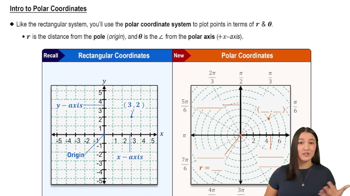
Polar coordinates represent a point in the plane using a radius and an angle, denoted as (r, θ). The radius r is the distance from the origin, and θ is the angle measured from the positive x-axis, usually in radians.
추천 영상:
05:32
Intro to Polar Coordinates

Conversion Formulas from Polar to Cartesian

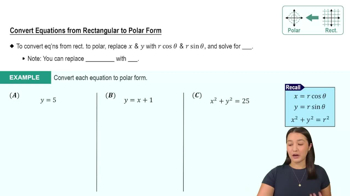
To convert polar coordinates (r, θ) to Cartesian coordinates (x, y), use the formulas x = r * cos(θ) and y = r * sin(θ). These relate the radius and angle to horizontal and vertical distances.
추천 영상:
3:37
Convert Equations from Rectangular to Polar

Special Case: Zero Radius

When the radius r is zero, the point is at the origin regardless of the angle θ. This means the Cartesian coordinates are always (0, 0) for any angle if r = 0.
추천 영상:
04:24
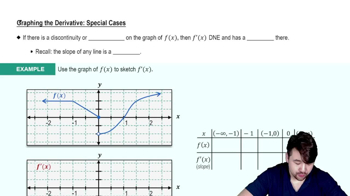
Graphing The Derivative - Special Cases