Ch. 2 - Limits and Continuity
2์žฅ, ๋ฌธ์ œ 32

Continuous Extension


Explain why the function ฦ’(๐“) = sin(1/๐“) has no continuous extension to ๐“ = 0.

๊ฒ€์ฆ๋œ ๋‹จ๊ณ„๋ณ„ ์•ˆ๋‚ด
1
To understand why the function ฦ’(๐“) = sin(1/๐“) has no continuous extension to ๐“ = 0, we first need to consider the behavior of the function as ๐“ approaches 0. The function is defined for all ๐“ โ‰  0, but we are interested in its behavior as ๐“ gets very close to 0.
As ๐“ approaches 0, the expression 1/๐“ becomes very large in magnitude, which means that the argument of the sine function oscillates rapidly between positive and negative values. This rapid oscillation causes the function ฦ’(๐“) = sin(1/๐“) to oscillate between -1 and 1 without settling down to any particular value.
For a function to have a continuous extension at a point, the limit of the function as it approaches that point must exist and be finite. In this case, we need to check if the limit of ฦ’(๐“) as ๐“ approaches 0 exists.
To determine the limit, consider the fact that for any sequence of values of ๐“ approaching 0, the corresponding sequence of values of 1/๐“ will cover all real numbers densely. This means that the values of sin(1/๐“) will cover the interval [-1, 1] densely as well, without converging to a single value.
Since the limit of ฦ’(๐“) as ๐“ approaches 0 does not exist (the function does not approach a single value), there is no way to define ฦ’(0) such that the function becomes continuous at ๐“ = 0. Therefore, ฦ’(๐“) = sin(1/๐“) has no continuous extension to ๐“ = 0.

๋น„์Šทํ•œ ๋ฌธ์ œ์— ๋Œ€ํ•œ ๊ฒ€์ฆ๋œ ์˜์ƒ ๋‹ต๋ณ€:

์ด ์˜์ƒ ํ•ด๋ฒ•์€ ์œ„ ๋ฌธ์ œ์— ๋„์›€์ด ๋œ๋‹ค๊ณ  ํŠœํ„ฐ๋“ค์ด ์ถ”์ฒœํ•œ ๊ฒƒ์ž…๋‹ˆ๋‹ค.
์˜์ƒ ๊ธธ์ด:
6m
๋„์›€์ด ๋˜์—ˆ๋‚˜์š”?

์ฃผ์š” ๊ฐœ๋…

์งˆ๋ฌธ์— ์˜ฌ๋ฐ”๋ฅด๊ฒŒ ๋‹ตํ•˜๊ธฐ ์œ„ํ•ด ๋ฐ˜๋“œ์‹œ ์ดํ•ดํ•ด์•ผ ํ•˜๋Š” ํ•ต์‹ฌ ๊ฐœ๋…๋“ค์€ ๋‹ค์Œ๊ณผ ๊ฐ™์Šต๋‹ˆ๋‹ค.

Limits

Limits are fundamental in calculus, representing the value that a function approaches as the input approaches a certain point. For the function ฦ’(๐“) = sin(1/๐“), we need to analyze the limit as ๐“ approaches 0. If the limit does not exist or is not finite, the function cannot be continuously extended to that point.
์ถ”์ฒœ ์˜์ƒ:
05:50
One-Sided Limits

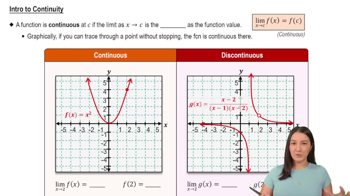
Continuity

A function is continuous at a point if the limit of the function as it approaches that point equals the function's value at that point. For ฦ’(๐“) = sin(1/๐“}, we find that as ๐“ approaches 0, the function oscillates between -1 and 1, indicating that it does not settle at a single value, thus failing the continuity requirement at ๐“ = 0.
์ถ”์ฒœ ์˜์ƒ:
05:34
Intro to Continuity

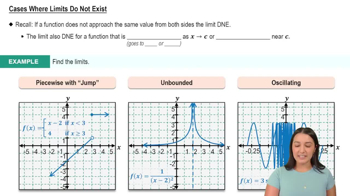
Oscillation

Oscillation refers to the behavior of a function that fluctuates between values without converging to a single limit. In the case of ฦ’(๐“) = sin(1/๐“), as ๐“ approaches 0, the function oscillates infinitely between -1 and 1, which means it does not approach any specific value, preventing a continuous extension to ๐“ = 0.
์ถ”์ฒœ ์˜์ƒ:
03:07
Cases Where Limits Do Not Exist
๊ด€๋ จ ์‹ค์ฒœ
๊ต๊ณผ์„œ ์งˆ๋ฌธ

Find the limits in Exercises 49โ€“52. Write โˆž or โˆ’โˆž where appropriate.


lim xโ†’(โˆ’ฯ€/2)โบ sec x

226
views
๊ต๊ณผ์„œ ์งˆ๋ฌธ

[Technology Exercise] Roots


Let ฦ’(๐“) = ๐“ยณ โ€•๐“โ€• 1.


b. Solve the equation ฦ’(๐“) = 0 graphically with an error of magnitude at most 10โปโธ .

175
views
๊ต๊ณผ์„œ ์งˆ๋ฌธ

Find the limits in Exercises 49โ€“52. Write โˆž or โˆ’โˆž where appropriate.


lim ฮธโ†’0 (2 โˆ’ cot ฮธ)

238
views
๊ต๊ณผ์„œ ์งˆ๋ฌธ

Finding Deltas Algebraically


Each of Exercises 15โ€“30 gives a function f(x) and numbers L, c, and ฮต>0. In each case, find the largest open interval about c on which the inequality |f(x)โˆ’L| <ฮต holds. Then give a value for ฮด>0 such that for all x satisfying 0 < |xโˆ’c| < ฮด, the inequality |f(x)โˆ’L| < ฮต holds.


f(x) = mx, m > 0, L = 2m, c = 2, ฮต = 0.03

306
views
๊ต๊ณผ์„œ ์งˆ๋ฌธ

[Technology Exercise] Roots


Let ฦ’(๐“) = ๐“ยณ โ€•๐“โ€• 1.


c. It can be shown that the exact value of the solution in part (b) is


(1/2 + โˆš69/18)ยน/ยณ + (1/2 โ€• โˆš69/18)ยน/ยณ


Evaluate this exact answer and compare it with the value you found in part (b).

168
views
๊ต๊ณผ์„œ ์งˆ๋ฌธ

[Technology Exercise] In Exercises 33โ€“36, graph the function to see whether it appears to have a continuous extension to the given point a. If it does, use Trace and Zoom to find a good candidate for the extended functionโ€™s value at a. If the function does not appear to have a continuous extension, can it be extended to be continuous from the right or left? If so, what do you think the extended functionโ€™s value should be?


g(ฮธ) = 5 cos ฮธ / (4ฮธ โ€• 2ฯ€) , a = ฯ€/2

248
views