Ch. 2 - Limits and Continuity
Hass - Thomas' Calculus 15th Edition
Hass15th EditionThomas' CalculusISBN: 9780137616077당신이 사용하는 게 아니라요?교과서 변경
2장, 문제 2.6.5

Finding Limits


In Exercises 3–8, find the limit of each function (a) as x → ∞ and (b) as x → −∞. (You may wish to visualize your answer with a graphing calculator or computer.)


g(x) = 1/(2 + (1/x))

검증된 단계별 안내
1
Step 1: Understand the function g(x) = 1/(2 + (1/x)). As x approaches infinity or negative infinity, the behavior of the function is influenced by the term (1/x).
Step 2: Consider the limit as x approaches infinity (x → ∞). As x becomes very large, the term (1/x) approaches 0. Therefore, the expression inside the denominator becomes 2 + 0 = 2.
Step 3: Simplify the function for x → ∞. The function g(x) simplifies to 1/2 when x is very large, since the (1/x) term becomes negligible.
Step 4: Now consider the limit as x approaches negative infinity (x → −∞). Similar to the previous case, as x becomes very large in the negative direction, the term (1/x) also approaches 0.
Step 5: Simplify the function for x → −∞. The function g(x) again simplifies to 1/2, as the (1/x) term becomes negligible, leaving the denominator as approximately 2.

비슷한 문제에 대한 검증된 영상 답변:

이 영상 해법은 위 문제에 도움이 된다고 튜터들이 추천한 것입니다.
영상 길이:
3m
도움이 되었나요?

주요 개념

질문에 올바르게 답하기 위해 반드시 이해해야 하는 핵심 개념들은 다음과 같습니다.

Limits

Limits are fundamental in calculus, representing the value that a function approaches as the input approaches a certain point. They are crucial for understanding the behavior of functions at specific points, including infinity. In this context, we are interested in evaluating the limits of the function g(x) as x approaches both positive and negative infinity.
추천 영상:
05:50
One-Sided Limits

Behavior at Infinity

When analyzing limits as x approaches infinity or negative infinity, we focus on the end behavior of the function. This involves determining how the function behaves as the input grows larger or smaller without bound. For rational functions, this often involves simplifying the expression to identify dominant terms that dictate the limit.
추천 영상:
03:07
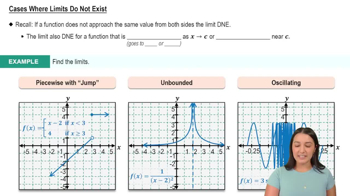
Cases Where Limits Do Not Exist

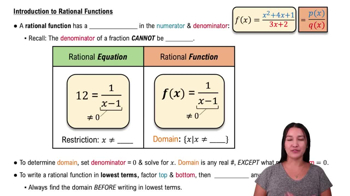
Rational Functions

Rational functions are ratios of polynomials, and their limits can often be evaluated by examining the degrees of the numerator and denominator. In the case of g(x) = 1/(2 + (1/x)), as x approaches infinity, the term (1/x) approaches zero, simplifying the function. Understanding how to manipulate and simplify rational functions is key to finding their limits.
추천 영상:
6:04
Intro to Rational Functions