

Ch. 2 - Limits and Continuity
Hass - Thomas' Calculus 15th Edition
Hass15th EditionThomas' CalculusISBN: 9780137616077당신이 사용하는 게 아니라요?교과서 변경
2장, 문제 2.2.37

Limits of quotients


Find the limits in Exercises 23–42.


limx→1 (x −1) / (√(x + 3) − 2)

검증된 단계별 안내
1
Identify the form of the limit: As x approaches 1, both the numerator (x - 1) and the denominator (√(x + 3) - 2) approach 0, indicating an indeterminate form 0/0.
To resolve the indeterminate form, consider rationalizing the denominator. Multiply the numerator and the denominator by the conjugate of the denominator: (√(x + 3) + 2).
Rewrite the expression: ((x - 1) * (√(x + 3) + 2)) / ((√(x + 3) - 2) * (√(x + 3) + 2)).
Simplify the denominator using the difference of squares formula: (√(x + 3))^2 - 2^2 = x + 3 - 4 = x - 1.
Cancel the common factor (x - 1) in the numerator and denominator, then evaluate the limit of the simplified expression as x approaches 1.

비슷한 문제에 대한 검증된 영상 답변:

이 영상 해법은 위 문제에 도움이 된다고 튜터들이 추천한 것입니다.
영상 길이:
3m
도움이 되었나요?

주요 개념

질문에 올바르게 답하기 위해 반드시 이해해야 하는 핵심 개념들은 다음과 같습니다.

Limits

Limits are fundamental in calculus, representing the value that a function approaches as the input approaches a certain point. They help in understanding the behavior of functions near specific points, especially when direct substitution leads to indeterminate forms. In this case, evaluating the limit as x approaches 1 requires careful manipulation to avoid division by zero.
추천 영상:
05:50
One-Sided Limits

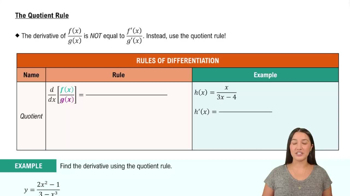
Quotient of Functions

The quotient of functions involves dividing one function by another. When finding limits of quotients, it is essential to analyze both the numerator and denominator to determine their behavior as the variable approaches a specific value. In this exercise, the expression (x - 1) in the numerator and the square root function in the denominator must be examined to simplify the limit.
추천 영상:
06:43
The Quotient Rule

Rationalization

Rationalization is a technique used to eliminate radicals from the denominator of a fraction. This is particularly useful when evaluating limits that result in indeterminate forms. In the given limit, multiplying the numerator and denominator by the conjugate of the denominator, √(x + 3) + 2, can simplify the expression and make it easier to evaluate the limit as x approaches 1.
추천 영상:
6:04
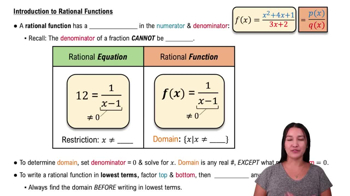
Intro to Rational Functions