
Ch. 2 - Limits and Continuity
Hass - Thomas' Calculus 15th Edition
Hass15th EditionThomas' CalculusISBN: 9780137616077당신이 사용하는 게 아니라요?교과서 변경
2장, 문제 2.2.10

If f(1)=5, must limx→1 f(x) exist? If it does, then must limx→1 f(x)=5? Can we conclude anything about limx→1 f(x)? Explain.

검증된 단계별 안내
1
To determine if \( \lim_{x \to 1} f(x) \) exists, we need to check if the function \( f(x) \) approaches a specific value as \( x \) approaches 1 from both the left and the right.
The existence of \( f(1) = 5 \) does not necessarily imply that \( \lim_{x \to 1} f(x) \) exists. A limit exists only if the left-hand limit and the right-hand limit are equal as \( x \) approaches 1.
If \( \lim_{x \to 1} f(x) \) does exist, it does not have to equal \( f(1) = 5 \). The limit describes the behavior of \( f(x) \) as \( x \) approaches 1, not necessarily the value of \( f(x) \) at \( x = 1 \).
To conclude anything about \( \lim_{x \to 1} f(x) \), we need more information about the behavior of \( f(x) \) near \( x = 1 \). For example, if \( f(x) \) is continuous at \( x = 1 \), then \( \lim_{x \to 1} f(x) = f(1) = 5 \).
In summary, without additional information about the continuity or behavior of \( f(x) \) near \( x = 1 \), we cannot definitively conclude the value of \( \lim_{x \to 1} f(x) \).

비슷한 문제에 대한 검증된 영상 답변:

이 영상 해법은 위 문제에 도움이 된다고 튜터들이 추천한 것입니다.
영상 길이:
4m
도움이 되었나요?

주요 개념

질문에 올바르게 답하기 위해 반드시 이해해야 하는 핵심 개념들은 다음과 같습니다.

Limit of a Function

The limit of a function describes the value that the function approaches as the input approaches a certain point. For a limit to exist at a point, the function must approach the same value from both the left and right sides of that point. This concept is fundamental in calculus as it helps in understanding continuity and the behavior of functions near specific points.
추천 영상:
06:11
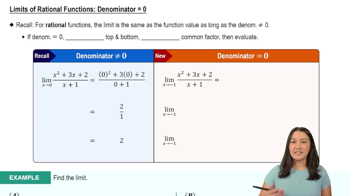
Limits of Rational Functions: Denominator = 0

Continuity

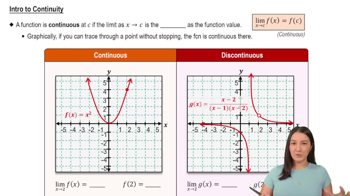
A function is continuous at a point if the limit of the function as it approaches that point equals the function's value at that point. In this case, if f(1) = 5 and the limit as x approaches 1 exists, then for the function to be continuous at x = 1, it must also hold that lim x→1 f(x) = 5. Continuity ensures that there are no jumps or breaks in the function at that point.
추천 영상:
05:34
Intro to Continuity

Existence of Limits

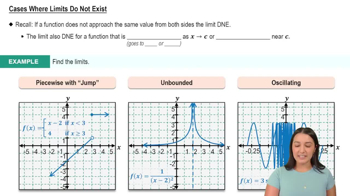
The existence of a limit does not necessarily imply that the function is defined at that point. In the given question, even if f(1) = 5, the limit lim x→1 f(x) may exist and be different from 5, or it may not exist at all. Understanding this distinction is crucial for analyzing the behavior of functions and their limits in calculus.
추천 영상:
03:07
Cases Where Limits Do Not Exist