Ch. 2 - Limits and Continuity
Hass - Thomas' Calculus 15th Edition
Hass15th EditionThomas' CalculusISBN: 9780137616077당신이 사용하는 게 아니라요?교과서 변경
2장, 문제 2.6.29

Limits as x → ∞ or x → −∞


The process by which we determine limits of rational functions applies equally well to ratios containing noninteger or negative powers of x. Divide numerator and denominator by the highest power of x in the denominator and proceed from there. Find the limits in Exercises 23–36. Write ∞ or −∞ where appropriate.


lim x→⁻∞ (³√x − ⁵√x) / (³√x + ⁵√x)

검증된 단계별 안내
1
Identify the highest power of x in the denominator. In this case, the highest power is the fifth root of x, which can be expressed as x^(1/5).
Divide both the numerator and the denominator by x^(1/5). This will help simplify the expression and make it easier to evaluate the limit.
Rewrite the expression: ((³√x)/x^(1/5) - (⁵√x)/x^(1/5)) / ((³√x)/x^(1/5) + (⁵√x)/x^(1/5)).
Simplify each term: ³√x is x^(1/3), so (³√x)/x^(1/5) becomes x^(1/3 - 1/5). Similarly, (⁵√x)/x^(1/5) becomes x^(1/5 - 1/5) = x^0 = 1.
Evaluate the limit as x approaches -∞. Consider the behavior of x^(1/3 - 1/5) as x approaches -∞, and use this to determine the limit of the entire expression.

비슷한 문제에 대한 검증된 영상 답변:

이 영상 해법은 위 문제에 도움이 된다고 튜터들이 추천한 것입니다.
영상 길이:
4m
도움이 되었나요?

주요 개념

질문에 올바르게 답하기 위해 반드시 이해해야 하는 핵심 개념들은 다음과 같습니다.

Limits at Infinity

Limits at infinity involve evaluating the behavior of a function as the variable approaches positive or negative infinity. This concept helps determine the end behavior of functions, particularly rational functions, by analyzing the leading terms. Understanding limits at infinity is crucial for identifying horizontal asymptotes and the overall growth or decay of functions.
추천 영상:
03:07
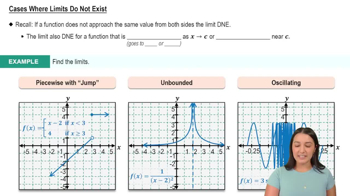
Cases Where Limits Do Not Exist

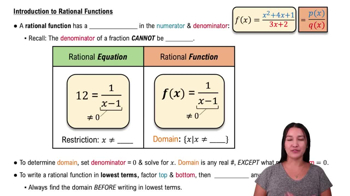
Rational Functions

Rational functions are expressions formed by the ratio of two polynomials. When evaluating limits of rational functions as x approaches infinity, it's essential to consider the degrees of the numerator and denominator. Simplifying the expression by dividing by the highest power of x in the denominator can reveal the function's behavior at infinity, aiding in limit calculation.
추천 영상:
6:04
Intro to Rational Functions

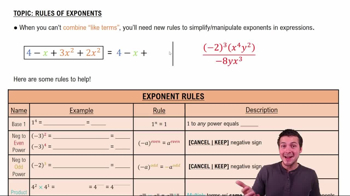
Roots and Exponents

Understanding roots and exponents is vital when dealing with expressions involving noninteger or negative powers of x. The cube root (³√x) and fifth root (⁵√x) are examples of fractional exponents, which can be rewritten as x^(1/3) and x^(1/5), respectively. Recognizing how these terms behave as x approaches infinity or negative infinity is key to simplifying and evaluating limits.
추천 영상:
가이드 코스
7:39
Introduction to Exponent Rules