Ch. 2 - Limits and Continuity
Hass - Thomas' Calculus 15th Edition
Hass15th EditionThomas' CalculusISBN: 9780137616077당신이 사용하는 게 아니라요?교과서 변경
2장, 문제 105

Oblique Asymptotes


Graph the rational functions in Exercises 103–108. Include the graphs and equations of the asymptotes.


y = (x² − 4) / (x − 1)

검증된 단계별 안내
1
Identify the type of asymptotes: Since the degree of the numerator (2) is one more than the degree of the denominator (1), there is an oblique (slant) asymptote.
Find the oblique asymptote: Perform polynomial long division of the numerator by the denominator. Divide \(x^2 - 4\) by \(x - 1\) to find the quotient, which will be the equation of the oblique asymptote.
Determine the vertical asymptote: Set the denominator equal to zero and solve for \(x\). In this case, \(x - 1 = 0\) gives \(x = 1\) as the vertical asymptote.
Analyze the behavior near the asymptotes: Consider the limits of the function as \(x\) approaches the vertical asymptote from both sides and as \(x\) approaches infinity to understand the behavior of the graph.
Sketch the graph: Plot the vertical asymptote at \(x = 1\), the oblique asymptote from the division result, and the intercepts. Use the behavior analysis to sketch the curve, ensuring it approaches the asymptotes appropriately.

비슷한 문제에 대한 검증된 영상 답변:

이 영상 해법은 위 문제에 도움이 된다고 튜터들이 추천한 것입니다.
영상 길이:
8m
도움이 되었나요?

주요 개념

질문에 올바르게 답하기 위해 반드시 이해해야 하는 핵심 개념들은 다음과 같습니다.

Rational Functions

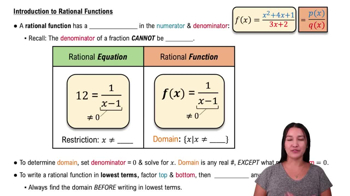
A rational function is a ratio of two polynomials, expressed as f(x) = P(x)/Q(x), where P(x) and Q(x) are polynomials. Understanding the behavior of rational functions involves analyzing their domain, intercepts, asymptotes, and end behavior. In this context, the function y = (x² − 4) / (x − 1) is a rational function where the degree of the numerator is higher than the degree of the denominator, indicating the presence of an oblique asymptote.
추천 영상:
6:04
Intro to Rational Functions

Oblique Asymptotes

Oblique asymptotes occur in rational functions when the degree of the numerator is exactly one higher than the degree of the denominator. They represent a slant line that the graph of the function approaches as x tends to infinity or negative infinity. To find the equation of an oblique asymptote, perform polynomial long division on the rational function, which provides the linear equation representing the asymptote.
추천 영상:
5:37
Introduction to Cotangent Graph

Polynomial Long Division

Polynomial long division is a method used to divide polynomials, similar to numerical long division. It is essential for finding oblique asymptotes in rational functions where the numerator's degree exceeds the denominator's by one. By dividing (x² − 4) by (x − 1), we obtain a quotient that represents the equation of the oblique asymptote, which helps in graphing the function accurately.
추천 영상:
6:04
Introduction to Polynomial Functions