Ch. 2 - Limits and Continuity
Hass - Thomas' Calculus 15th Edition
Hass15th EditionThomas' CalculusISBN: 9780137616077당신이 사용하는 게 아니라요?교과서 변경
2장, 문제 113a

[Technology Exercise] Graph the functions in Exercises 113 and 114. Then answer the following questions.


a. How does the graph behave as x → 0⁺?


Give reasons for your answers.


y = (3/2)(x − (1 / x))²/³

검증된 단계별 안내
1
Step 1: Begin by understanding the function y = (3/2)(x - (1/x))^(2/3). This function involves a fractional exponent and a rational expression inside the parentheses. The goal is to graph this function and analyze its behavior as x approaches 0 from the positive side.
Step 2: Consider the expression inside the parentheses: x - (1/x). As x approaches 0 from the positive side, x becomes very small, and 1/x becomes very large. This means the expression x - (1/x) will tend towards negative infinity.
Step 3: Next, consider the exponent (2/3). When a negative number is raised to a fractional power, the result depends on the specific fraction. In this case, the exponent is positive, so the function will tend towards positive infinity as x approaches 0 from the positive side.
Step 4: Graph the function using a graphing tool or software. Observe the behavior of the graph as x approaches 0 from the positive side. You should see the graph rising steeply, indicating that the function value increases without bound.
Step 5: To provide reasons for the behavior, note that the dominant term as x approaches 0 is the negative infinity from x - (1/x), which when raised to the power of (2/3) results in a large positive value. This explains the steep rise in the graph as x approaches 0 from the positive side.

비슷한 문제에 대한 검증된 영상 답변:

이 영상 해법은 위 문제에 도움이 된다고 튜터들이 추천한 것입니다.
영상 길이:
3m
도움이 되었나요?

주요 개념

질문에 올바르게 답하기 위해 반드시 이해해야 하는 핵심 개념들은 다음과 같습니다.

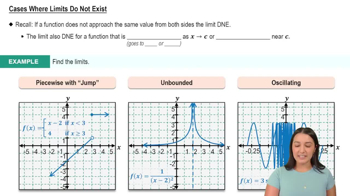
Limits and Behavior Near a Point

Understanding how a function behaves as x approaches a specific value, such as 0⁺, involves analyzing limits. This concept helps determine the function's tendency, whether it approaches a finite value, infinity, or oscillates. For the given function, evaluating the limit as x approaches 0 from the positive side is crucial to predict its behavior.
추천 영상:
03:07
Cases Where Limits Do Not Exist

Graphing Functions

Graphing functions involves plotting points to visualize the function's behavior across different values of x. This helps identify key features such as intercepts, asymptotes, and overall shape. For the function y = (3/2)(x − (1 / x))²/³, graphing aids in understanding how the function behaves near x = 0 and supports the analysis of its limit.
추천 영상:
5:53
Graph of Sine and Cosine Function

Exponentiation and Roots

Exponentiation and roots are fundamental operations affecting the function's growth and decay rates. The expression (x − (1 / x))²/³ involves both squaring and taking a cube root, which influences the function's smoothness and continuity. Understanding these operations is essential for analyzing how the function behaves as x approaches 0⁺, especially in terms of steepness and direction.
추천 영상:
6:13
Exponential Functions