Ch. 2 - Limits and Continuity
Hass - Thomas' Calculus 15th Edition
Hass15th EditionThomas' CalculusISBN: 9780137616077당신이 사용하는 게 아니라요?교과서 변경
2장, 문제 2.6.95

Use formal definitions to prove the limit statements in Exercises 93–96.


lim x → 3 (−2 / (x − 3)²) = −∞

검증된 단계별 안내
1
Understand the problem: We need to prove that the limit of the function \(-\frac{2}{(x-3)^2}\) as \(x\) approaches 3 is \(-\infty\). This involves using the formal definition of limits involving infinity.
Recall the formal definition: For a limit to be \(-\infty\) as \(x\) approaches a value \(c\), for every positive number \(M\), there exists a \(\delta > 0\) such that if \(0 < |x - c| < \delta\), then \(f(x) < -M\).
Apply the definition: We need to show that for every \(M > 0\), there exists a \(\delta > 0\) such that if \(0 < |x - 3| < \delta\), then \(-\frac{2}{(x-3)^2} < -M\).
Solve the inequality: Start by solving \(-\frac{2}{(x-3)^2} < -M\). This simplifies to \(\frac{2}{(x-3)^2} > M\). Rearrange to find \(x\) values that satisfy this inequality.
Determine \(\delta\): From the inequality \((x-3)^2 < \frac{2}{M}\), solve for \(x\) to find \(\delta\) such that \(0 < |x - 3| < \delta\) ensures the inequality holds. This will complete the proof using the formal definition.

비슷한 문제에 대한 검증된 영상 답변:

이 영상 해법은 위 문제에 도움이 된다고 튜터들이 추천한 것입니다.
영상 길이:
3m
도움이 되었나요?

주요 개념

질문에 올바르게 답하기 위해 반드시 이해해야 하는 핵심 개념들은 다음과 같습니다.

Limit Definition

The formal definition of a limit involves showing that for every ε > 0, there exists a δ > 0 such that if 0 < |x - c| < δ, then |f(x) - L| < ε. In this context, proving a limit involves demonstrating that as x approaches a specific value, the function approaches a particular limit, which can be finite or infinite.
추천 영상:
05:43
Definition of the Definite Integral

Infinite Limits

Infinite limits occur when the value of a function increases or decreases without bound as the input approaches a certain point. In this problem, the limit is negative infinity, indicating that as x approaches 3, the function value decreases indefinitely. Understanding infinite limits requires recognizing how the function behaves near the point of interest.
추천 영상:
05:50
One-Sided Limits

Behavior Near Singularities

Singularities are points where a function is not defined or behaves erratically, often leading to infinite limits. In this problem, x = 3 is a singularity for the function −2/(x−3)², as the denominator approaches zero, causing the function to diverge. Analyzing behavior near singularities involves examining how the function's value changes as it approaches these critical points.
추천 영상:
03:07
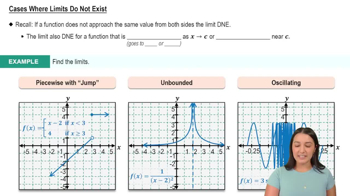
Cases Where Limits Do Not Exist
관련 실천
교과서 질문

Define h(2) in a way that extends h(t) = (t² + 3t − 10)/(t − 2) to be continuous at t = 2.

241
views

교과서 질문

Using Limit Rules


Suppose lim x→0 f(x) = 1 and lim x→0 g(x) = −5. Name the rules in Theorem 1 that are used to accomplish steps (a), (b), and (c) of the following calculation.


limx→0 (2f(x) − g(x)) / (f(x) + 7)² = limx→0 (2f(x) − g(x)) / limx→0 (f(x) + 7)² (a)


(We assume the denominator is nonzero.)


(lim x→0 2f(x) − lim x→0 g(x)) / (lim x→0 (f(x) + 7))² (b)


= (2 lim x→0 f(x) − lim x→0 g(x)) / (lim x→0 f(x) + lim x→0 7)² (c)


= ((2)(1) − (−5)) / (1 + 7)² = 7/64

207
views
교과서 질문

For what values of a and b is

g(x) = { ax + 2b, x ≤ 0

x² + 3a – b, 0 < x ≤ 2

3x – 5, x > 2

continuous at every x?

257
views
교과서 질문

The sign-preserving property of continuous functions Let f be defined on an interval (a, b) and suppose that f(c) ≠ 0 at some c where f is continuous. Show that there is an interval (c − δ, c + δ) about c where f has the same sign as f(c).

409
views
교과서 질문

Suppose that f(x) and g(x) are polynomials in x. Can the graph of f(x)/g(x) have an asymptote if g(x) is never zero? Give reasons for your answer.

335
views
교과서 질문

Limits as x → ∞ or x → −∞


The process by which we determine limits of rational functions applies equally well to ratios containing noninteger or negative powers of x. Divide numerator and denominator by the highest power of x in the denominator and proceed from there. Find the limits in Exercises 23–36. Write ∞ or −∞ where appropriate.


lim x → ∞ √((8x² − 3) / (2x² + x))

368
views