Define h(2) in a way that extends h(t) = (t² + 3t − 10)/(t − 2) to be continuous at t = 2.
Ch. 2 - Limits and Continuity
2장, 문제 2.2.51
Using Limit Rules
Suppose lim x→0 f(x) = 1 and lim x→0 g(x) = −5. Name the rules in Theorem 1 that are used to accomplish steps (a), (b), and (c) of the following calculation.
limx→0 (2f(x) − g(x)) / (f(x) + 7)² = limx→0 (2f(x) − g(x)) / limx→0 (f(x) + 7)² (a)
(We assume the denominator is nonzero.)
(lim x→0 2f(x) − lim x→0 g(x)) / (lim x→0 (f(x) + 7))² (b)
= (2 lim x→0 f(x) − lim x→0 g(x)) / (lim x→0 f(x) + lim x→0 7)² (c)
= ((2)(1) − (−5)) / (1 + 7)² = 7/64
검증된 단계별 안내1
Step 1: Identify the limit expression given: lim_{x→0} (2f(x) − g(x)) / (f(x) + 7)². We need to apply limit rules to simplify this expression.
Step 2: Apply the Quotient Rule for limits, which states that lim_{x→a} [u(x)/v(x)] = [lim_{x→a} u(x)] / [lim_{x→a} v(x)], provided lim_{x→a} v(x) ≠ 0. This allows us to separate the limit of the numerator and the denominator.
Step 3: For the numerator, apply the Sum/Difference Rule for limits: lim_{x→a} [u(x) ± v(x)] = lim_{x→a} u(x) ± lim_{x→a} v(x). This lets us separate the terms 2f(x) and -g(x) into individual limits.
Step 4: For the term 2f(x), apply the Constant Multiple Rule: lim_{x→a} [c * u(x)] = c * lim_{x→a} u(x). This allows us to take the constant 2 out of the limit.
Step 5: For the denominator, apply the Sum Rule and the Constant Rule: lim_{x→a} [u(x) + c] = lim_{x→a} u(x) + c, where c is a constant. This simplifies the denominator to (lim_{x→0} f(x) + 7)².

비슷한 문제에 대한 검증된 영상 답변:
이 영상 해법은 위 문제에 도움이 된다고 튜터들이 추천한 것입니다.
영상 길이:
4m도움이 되었나요?
주요 개념
질문에 올바르게 답하기 위해 반드시 이해해야 하는 핵심 개념들은 다음과 같습니다.
Limit of a Function
The limit of a function describes the value that a function approaches as the input approaches a certain point. In this case, we have limits for f(x) and g(x) as x approaches 0, which are essential for evaluating the overall limit of the expression. Understanding limits is fundamental in calculus as it lays the groundwork for concepts like continuity and derivatives.
추천 영상:
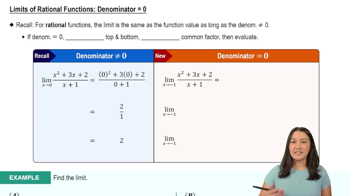
Limits of Rational Functions: Denominator = 0
Limit Laws
Limit laws are a set of rules that allow us to manipulate limits algebraically. These include properties such as the sum, difference, product, and quotient of limits. In the given problem, these laws are applied to break down the limit of a complex expression into simpler parts, making it easier to evaluate the limit as x approaches 0.
추천 영상:
One-Sided Limits
Continuity and Non-zero Denominator
For a limit to be evaluated using the quotient rule, the denominator must be non-zero at the point of interest. Continuity ensures that the function behaves predictably around that point. In this problem, it is assumed that the denominator (f(x) + 7)² does not approach zero as x approaches 0, allowing the application of limit laws without encountering undefined behavior.
추천 영상:
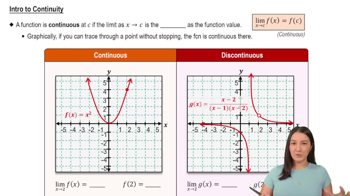
Intro to Continuity
관련 실천
교과서 질문
241
views
교과서 질문
For what values of a and b is
g(x) = { ax + 2b, x ≤ 0
x² + 3a – b, 0 < x ≤ 2
3x – 5, x > 2
continuous at every x?
257
views
교과서 질문
Using the Formal Definition
Prove the limit statements in Exercises 37–50.
limx→9 √(x − 5) = 2
317
views
교과서 질문
Use formal definitions to prove the limit statements in Exercises 93–96.
lim x → 3 (−2 / (x − 3)²) = −∞
266
views
교과서 질문
The sign-preserving property of continuous functions Let f be defined on an interval (a, b) and suppose that f(c) ≠ 0 at some c where f is continuous. Show that there is an interval (c − δ, c + δ) about c where f has the same sign as f(c).
409
views
교과서 질문
Suppose that f(x) and g(x) are polynomials in x. Can the graph of f(x)/g(x) have an asymptote if g(x) is never zero? Give reasons for your answer.
335
views