Ch. 3 - Derivatives
Hass - Thomas' Calculus 15th Edition
Hass15th EditionThomas' CalculusISBN: 9780137616077당신이 사용하는 게 아니라요?교과서 변경
3장, 문제 29

Airplane takeoff Suppose that the distance an aircraft travels along a runway before takeoff is given by D = (10/9)t², where D is measured in meters from the starting point and t is measured in seconds from the time the brakes are released. The aircraft will become airborne when its speed reaches 200 km/h. How long will it take to become airborne, and what distance will it travel in that time?

검증된 단계별 안내
1
First, convert the speed from km/h to m/s. Since 1 km/h is equal to 1/3.6 m/s, convert 200 km/h to m/s by multiplying 200 by 1/3.6.
Next, find the expression for speed as a function of time by differentiating the distance function D = (10/9)t² with respect to time t. This gives the velocity function v(t) = dD/dt.
Set the velocity function equal to the converted speed in m/s to find the time t when the aircraft becomes airborne. Solve the equation v(t) = converted speed for t.
Substitute the value of t found in the previous step back into the original distance function D = (10/9)t² to find the distance traveled by the aircraft at the time it becomes airborne.
Verify the units and calculations to ensure that the time and distance are consistent with the problem's requirements, ensuring the solution is physically meaningful.

비슷한 문제에 대한 검증된 영상 답변:

이 영상 해법은 위 문제에 도움이 된다고 튜터들이 추천한 것입니다.
영상 길이:
3m
도움이 되었나요?

주요 개념

질문에 올바르게 답하기 위해 반드시 이해해야 하는 핵심 개념들은 다음과 같습니다.

Kinematics and Speed

Kinematics involves the study of motion without considering its causes. Speed is a key aspect, defined as the rate of change of distance with respect to time. In this problem, the aircraft's speed must reach 200 km/h for takeoff, requiring conversion to meters per second (55.56 m/s) to match the units used in the equation for distance.
추천 영상:
가이드 코스
10:17
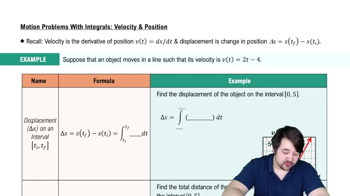
Using The Velocity Function

Differentiation

Differentiation is a fundamental concept in calculus used to find the rate at which a quantity changes. To determine the aircraft's speed, differentiate the distance function D = (10/9)t² with respect to time t. This yields the velocity function, v(t) = (20/9)t, which can be used to find the time when the speed reaches 55.56 m/s.
추천 영상:
가이드 코스
05:53
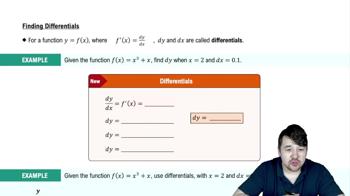
Finding Differentials

Solving Quadratic Equations

Solving quadratic equations is essential for finding specific values of variables that satisfy given conditions. Once the velocity function is set equal to the required speed, solve the resulting equation (20/9)t = 55.56 for t. This will provide the time needed for the aircraft to reach the necessary speed for takeoff.
추천 영상:
5:02
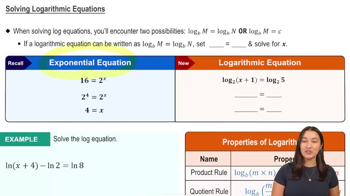
Solving Logarithmic Equations
관련 실천
교과서 질문

Slopes and Tangent Lines


a. Horizontal tangent lines Find equations for the horizontal tangent lines to the curve y = x³ − 3x − 2. Also find equations for the lines that are perpendicular to these tangent lines at the points of tangency.

329
views
교과서 질문

The number of gallons of water in a tank t minutes after the tank has started to drain is Q(t) = 200(30 - t)². How fast is the water running out at the end of 10 min? What is the average rate at which the water flows out during the first 10 min?

261
views
교과서 질문

[Technology Exercise]


Draining a tank It takes 12 hours to drain a storage tank by opening the valve at the bottom. The depth y of fluid in the tank t hours after the valve is opened is given by the formula


y = 6(1 - t/12)² m.


b. When is the fluid level in the tank falling fastest? Slowest? What are the values of dy/dt at these times?

235
views
교과서 질문

Vehicular stopping distance Based on data from the U.S. Bureau of Public Roads, a model for the total stopping distance of a moving car in terms of its speed is s = 1.1v + 0.054v², where s is measured in ft and v in mph. The linear term 1.1v models the distance the car travels during the time the driver perceives a need to stop until the brakes are applied, and the quadratic term 0.054v² models the additional braking distance once they are applied. Find ds/dv at v = 35 and v = 70 mph, and interpret the meaning of the derivative.

208
views
교과서 질문

Slopes and Tangent Lines


b. Smallest slope What is the smallest slope on the curve? At what point on the curve does the curve have this slope?

298
views
교과서 질문

Find by implicit differentiation.

x² + xy + y² - 5x = 2

289
views