
Ch. 3 - Derivatives
Hass - Thomas' Calculus 15th Edition
Hass15th EditionThomas' CalculusISBN: 9780137616077당신이 사용하는 게 아니라요?교과서 변경
3장, 문제 25b

[Technology Exercise]


Draining a tank It takes 12 hours to drain a storage tank by opening the valve at the bottom. The depth y of fluid in the tank t hours after the valve is opened is given by the formula


y = 6(1 - t/12)² m.


b. When is the fluid level in the tank falling fastest? Slowest? What are the values of dy/dt at these times?

검증된 단계별 안내
1
To determine when the fluid level is falling fastest or slowest, we need to find the derivative of the depth function y with respect to time t, which is dy/dt. This will give us the rate of change of the fluid depth over time.
The given formula for the depth y is y = 6(1 - t/12)². First, apply the chain rule to differentiate this function with respect to t. Let u = 1 - t/12, then y = 6u². The derivative dy/dt is found by differentiating y with respect to u and then multiplying by du/dt.
Differentiate y = 6u² with respect to u to get dy/du = 12u. Then, differentiate u = 1 - t/12 with respect to t to get du/dt = -1/12.
Now, substitute back to find dy/dt: dy/dt = 12u * (-1/12) = -u. Since u = 1 - t/12, dy/dt = -(1 - t/12).
To find when the fluid level is falling fastest or slowest, analyze the expression for dy/dt. The fluid level falls fastest when dy/dt is at its minimum value, and slowest when dy/dt is at its maximum value. Evaluate dy/dt at the endpoints of the interval [0, 12] to determine these times.

비슷한 문제에 대한 검증된 영상 답변:

이 영상 해법은 위 문제에 도움이 된다고 튜터들이 추천한 것입니다.
영상 길이:
5m
도움이 되었나요?

주요 개념

질문에 올바르게 답하기 위해 반드시 이해해야 하는 핵심 개념들은 다음과 같습니다.

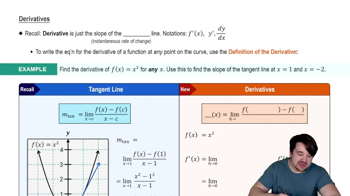
Derivative

The derivative of a function represents the rate of change of the function with respect to a variable. In this context, dy/dt indicates how the depth of the fluid in the tank changes over time. Calculating the derivative helps determine when the fluid level is falling fastest or slowest by identifying critical points where the rate of change is maximized or minimized.
추천 영상:

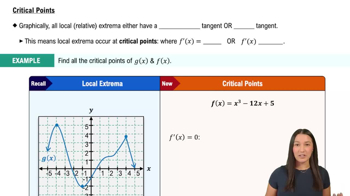
Critical Points

Critical points occur where the derivative of a function is zero or undefined, indicating potential maxima, minima, or points of inflection. To find when the fluid level is falling fastest or slowest, we need to find the critical points of dy/dt. These points help identify the times when the rate of change of the fluid level is at its extreme values.
추천 영상:
04:50
Critical Points

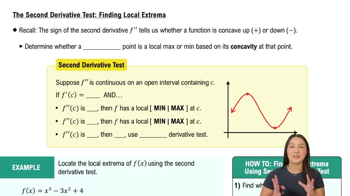
Second Derivative Test

The second derivative test helps determine the nature of critical points found using the first derivative. By evaluating the second derivative at these points, we can ascertain whether they correspond to local maxima, minima, or points of inflection. In this problem, applying the second derivative test to dy/dt will reveal when the fluid level is falling fastest (maximum rate) or slowest (minimum rate).
추천 영상:
06:02
The Second Derivative Test: Finding Local Extrema
관련 실천
교과서 질문

The number of gallons of water in a tank t minutes after the tank has started to drain is Q(t) = 200(30 - t)². How fast is the water running out at the end of 10 min? What is the average rate at which the water flows out during the first 10 min?

261
views
교과서 질문

[Technology Exercise]


Draining a tank It takes 12 hours to drain a storage tank by opening the valve at the bottom. The depth y of fluid in the tank t hours after the valve is opened is given by the formula


y = 6(1 - t/12)² m.


a. Find the rate dy/dt (m/h) at which the tank is draining at time t.

244
views
교과서 질문

Vehicular stopping distance Based on data from the U.S. Bureau of Public Roads, a model for the total stopping distance of a moving car in terms of its speed is s = 1.1v + 0.054v², where s is measured in ft and v in mph. The linear term 1.1v models the distance the car travels during the time the driver perceives a need to stop until the brakes are applied, and the quadratic term 0.054v² models the additional braking distance once they are applied. Find ds/dv at v = 35 and v = 70 mph, and interpret the meaning of the derivative.

208
views
교과서 질문

Using the Alternative Formula for Derivatives


Use the formula

f'(x) = lim (z → x) (f(z) − f(x)) / (z − x)

to find the derivative of the functions in Exercises 23–26.


f(x) = x² − 3x + 4

272
views
교과서 질문

Additional Applications


Bacterium population

When a bactericide was added to a nutrient broth in which bacteria were growing, the bacterium population continued to grow for a while, but then stopped growing and began to decline. The size of the population at time t (hours) was b = 10⁶ + 10⁴t − 10³t². Find the growth rates at


a. t = 0 hours.

b. t = 5 hours.

c. t = 10 hours.

217
views
교과서 질문

Airplane takeoff Suppose that the distance an aircraft travels along a runway before takeoff is given by D = (10/9)t², where D is measured in meters from the starting point and t is measured in seconds from the time the brakes are released. The aircraft will become airborne when its speed reaches 200 km/h. How long will it take to become airborne, and what distance will it travel in that time?

220
views