
Ch. 3 - Derivatives
Hass - Thomas' Calculus 15th Edition
Hass15th EditionThomas' CalculusISBN: 9780137616077당신이 사용하는 게 아니라요?교과서 변경
3장, 문제 3.2.48c

Differentiability and Continuity on an Interval


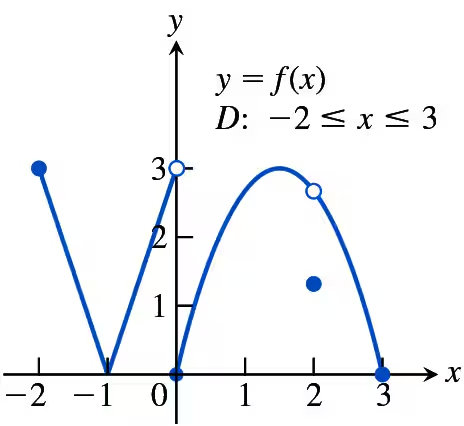
Each figure in Exercises 45–50 shows the graph of a function over a closed interval D. At what domain points does the function appear to be


c. neither continuous nor differentiable?


Give reasons for your answers.


Graph of a function with marked points indicating continuity and differentiability over the interval from -2 to 3.

검증된 단계별 안내
1
Examine the graph for any points where there is a jump, hole, or vertical asymptote, as these indicate discontinuity.
Identify the point at x = 0, where there is a hole in the graph, indicating the function is not continuous at this point.
Check for differentiability by looking for sharp corners or cusps in the graph, as these indicate non-differentiability.
Notice the sharp corner at x = -1, which suggests the function is not differentiable at this point.
Conclude that the function is neither continuous nor differentiable at x = 0 due to the hole, and not differentiable at x = -1 due to the sharp corner.

비슷한 문제에 대한 검증된 영상 답변:

이 영상 해법은 위 문제에 도움이 된다고 튜터들이 추천한 것입니다.
영상 길이:
3m
도움이 되었나요?

주요 개념

질문에 올바르게 답하기 위해 반드시 이해해야 하는 핵심 개념들은 다음과 같습니다.

Continuity

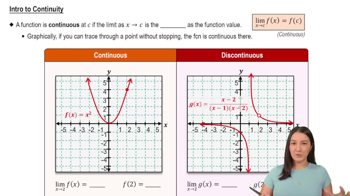
A function is continuous at a point if the limit of the function as it approaches that point equals the function's value at that point. This means there are no breaks, jumps, or holes in the graph at that point. For a function to be continuous over an interval, it must be continuous at every point within that interval.
추천 영상:
05:34
Intro to Continuity

Differentiability

A function is differentiable at a point if it has a defined derivative at that point, which implies that the function must be continuous there. Differentiability also requires that the graph has a tangent line at that point, meaning it cannot have sharp corners or vertical tangents. If a function is not continuous at a point, it cannot be differentiable there.
추천 영상:
가이드 코스
05:53
Finding Differentials

Points of Non-Continuity and Non-Differentiability

Points where a function is neither continuous nor differentiable typically include locations where there are jumps, vertical tangents, or corners in the graph. In the provided graph, such points can be identified by observing where the function does not meet the criteria for continuity or where the slope abruptly changes, indicating a lack of differentiability.
추천 영상:
03:38
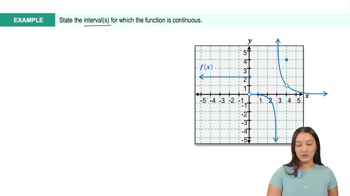
Intro to Continuity Example 1
관련 실천
교과서 질문

Analyzing Motion Using Graphs


[Technology Exercise] Exercises 31–34 give the position function s = f(t) of an object moving along the s-axis as a function of time t. Graph f together with the velocity function v(t) = ds/dt = f'(t) and the acceleration function a(t) = d²s/dt² = f''(t). Comment on the object’s behavior in relation to the signs and values of v and a. Include in your commentary such topics as the following:


c. When does it change direction?


s = t² - 3t + 2, 0 ≤ t ≤ 5

177
views
교과서 질문

Computer Explorations


Use a CAS to perform the following steps in Exercises 55–62.


b. Using implicit differentiation, find a formula for the derivative dy/dx and evaluate it at the given point P.


2y² + (xy)¹/³ = x² + 2, P(1,1)

191
views
교과서 질문

Theory and Examples


In Exercises 51–54,


c. For what values of x, if any, is f' positive? Zero? Negative?


y = −x²

157
views
교과서 질문

Suppose that functions ƒ(x) and g(x) and their first derivatives have the following values at x = 0 and x = 1.


x ƒ(x) g(x) ƒ'(x) g'(x)

0 1 1 -3 1/2

1 3 5 1/2 -4


Find the first derivatives of the following combinations at the given value of x.


c. ƒ(x) , x = 1

g(x) + 1

208
views
교과서 질문

The folium of Descartes (See Figure 3.27)


c. Find the coordinates of the point A in Figure 3.29 where the folium has a vertical tangent line.


384
views
교과서 질문

Diagonals If x, y, and z are lengths of the edges of a rectangular box, then the common length of the box’s diagonals is s = √(x² + y² + z²).

c. How are dx/dt, dy/dt, and dz/dt related if s is constant?

194
views