

Ch. 3 - Derivatives
Hass - Thomas' Calculus 15th Edition
Hass15th EditionThomas' CalculusISBN: 9780137616077당신이 사용하는 게 아니라요?교과서 변경
3장, 문제 3.2.51c

Theory and Examples


In Exercises 51–54,


c. For what values of x, if any, is f' positive? Zero? Negative?


y = −x²

검증된 단계별 안내
1
First, find the derivative of the function y = -x². The derivative, denoted as f', represents the rate of change of the function. Use the power rule for differentiation, which states that the derivative of x^n is n*x^(n-1).
Apply the power rule to y = -x². The derivative of -x² is f'(x) = -2x. This is because the derivative of x² is 2x, and the negative sign remains as a constant factor.
To determine where f' is positive, set the derivative -2x > 0 and solve for x. This inequality will tell you the range of x values where the function is increasing.
To find where f' is zero, set the derivative -2x = 0 and solve for x. This will give you the x value where the function has a horizontal tangent, indicating a potential maximum or minimum point.
To determine where f' is negative, set the derivative -2x < 0 and solve for x. This inequality will tell you the range of x values where the function is decreasing.

비슷한 문제에 대한 검증된 영상 답변:

이 영상 해법은 위 문제에 도움이 된다고 튜터들이 추천한 것입니다.
영상 길이:
2m
도움이 되었나요?

주요 개념

질문에 올바르게 답하기 위해 반드시 이해해야 하는 핵심 개념들은 다음과 같습니다.

Derivative

The derivative of a function, denoted as f', represents the rate of change of the function with respect to its variable. It provides information about the slope of the tangent line to the curve at any given point. For the function y = -x², the derivative helps determine where the function is increasing, decreasing, or has a horizontal tangent.
추천 영상:

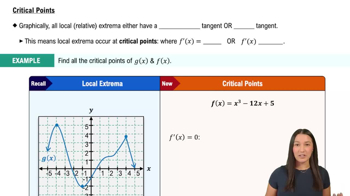
Critical Points

Critical points occur where the derivative of a function is zero or undefined. These points are important for identifying where a function changes from increasing to decreasing or vice versa. For y = -x², finding the critical points involves setting the derivative equal to zero and solving for x, which helps in analyzing the behavior of the function.
추천 영상:
04:50
Critical Points

Sign of the Derivative

The sign of the derivative indicates whether a function is increasing or decreasing. If f' is positive, the function is increasing; if f' is negative, the function is decreasing; and if f' is zero, the function has a horizontal tangent. Analyzing the sign of the derivative for y = -x² helps determine the intervals where the function is increasing, decreasing, or constant.
추천 영상:
관련 실천
교과서 질문

Analyzing Motion Using Graphs


[Technology Exercise] Exercises 31–34 give the position function s = f(t) of an object moving along the s-axis as a function of time t. Graph f together with the velocity function v(t) = ds/dt = f'(t) and the acceleration function a(t) = d²s/dt² = f''(t). Comment on the object’s behavior in relation to the signs and values of v and a. Include in your commentary such topics as the following:


c. When does it change direction?


s = t² - 3t + 2, 0 ≤ t ≤ 5

177
views
교과서 질문

Right circular cylinder The total surface area S of a right circular cylinder is related to the base radius r and height h by the equation S = 2πr² + 2πrh.


c. How is dS/dt related to dr/dt and dh/dt if neither r nor h is constant?

934
views
교과서 질문

Suppose that functions ƒ(x) and g(x) and their first derivatives have the following values at x = 0 and x = 1.


x ƒ(x) g(x) ƒ'(x) g'(x)

0 1 1 -3 1/2

1 3 5 1/2 -4


Find the first derivatives of the following combinations at the given value of x.


c. ƒ(x) , x = 1

g(x) + 1

208
views
교과서 질문

The folium of Descartes (See Figure 3.27)


c. Find the coordinates of the point A in Figure 3.29 where the folium has a vertical tangent line.


384
views
교과서 질문

Diagonals If x, y, and z are lengths of the edges of a rectangular box, then the common length of the box’s diagonals is s = √(x² + y² + z²).

c. How are dx/dt, dy/dt, and dz/dt related if s is constant?

194
views
교과서 질문

Differentiability and Continuity on an Interval


Each figure in Exercises 45–50 shows the graph of a function over a closed interval D. At what domain points does the function appear to be


c. neither continuous nor differentiable?


Give reasons for your answers.


257
views