Ch. 3 - Derivatives
Hass - Thomas' Calculus 15th Edition
Hass15th EditionThomas' CalculusISBN: 9780137616077당신이 사용하는 게 아니라요?교과서 변경
3장, 문제 3.6.29

Find the derivatives of the functions in Exercises 19–40.


y = (4x + 3)⁴(x + 1)⁻³

검증된 단계별 안내
1
Identify the function as a product of two functions: \( u(x) = (4x + 3)^4 \) and \( v(x) = (x + 1)^{-3} \). We will use the product rule for differentiation, which states that if \( y = u(x) \cdot v(x) \), then \( y' = u'(x) \cdot v(x) + u(x) \cdot v'(x) \).
Differentiate \( u(x) = (4x + 3)^4 \) using the chain rule. Let \( z = 4x + 3 \), then \( u(x) = z^4 \). The derivative \( u'(x) = 4z^3 \cdot \frac{d}{dx}(4x + 3) \). Since \( \frac{d}{dx}(4x + 3) = 4 \), we have \( u'(x) = 16(4x + 3)^3 \).
Differentiate \( v(x) = (x + 1)^{-3} \) using the power rule. The derivative \( v'(x) = -3(x + 1)^{-4} \cdot \frac{d}{dx}(x + 1) \). Since \( \frac{d}{dx}(x + 1) = 1 \), we have \( v'(x) = -3(x + 1)^{-4} \).
Apply the product rule: \( y' = u'(x) \cdot v(x) + u(x) \cdot v'(x) \). Substitute \( u'(x) = 16(4x + 3)^3 \), \( v(x) = (x + 1)^{-3} \), \( u(x) = (4x + 3)^4 \), and \( v'(x) = -3(x + 1)^{-4} \).
Simplify the expression: \( y' = 16(4x + 3)^3(x + 1)^{-3} - 3(4x + 3)^4(x + 1)^{-4} \). Factor and combine like terms if possible to simplify further.

비슷한 문제에 대한 검증된 영상 답변:

이 영상 해법은 위 문제에 도움이 된다고 튜터들이 추천한 것입니다.
영상 길이:
8m
도움이 되었나요?

주요 개념

질문에 올바르게 답하기 위해 반드시 이해해야 하는 핵심 개념들은 다음과 같습니다.

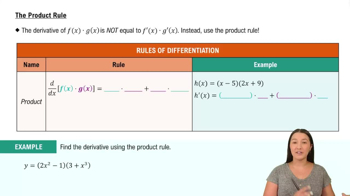
Product Rule

The product rule is a fundamental technique in calculus used to find the derivative of a product of two functions. If you have two functions, u(x) and v(x), the derivative of their product is given by u'(x)v(x) + u(x)v'(x). This rule is essential when differentiating expressions where two functions are multiplied together, as seen in the given problem.
추천 영상:
05:18
The Product Rule

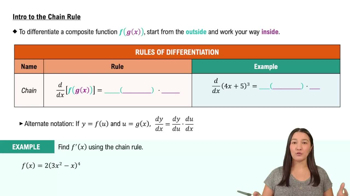
Chain Rule

The chain rule is a method for differentiating composite functions, where one function is nested inside another. If you have a function y = f(g(x)), the derivative is found by taking the derivative of the outer function f with respect to g, and then multiplying it by the derivative of the inner function g with respect to x. This rule is crucial for handling expressions with powers, such as (4x + 3)⁴ in the problem.
추천 영상:
05:02
Intro to the Chain Rule

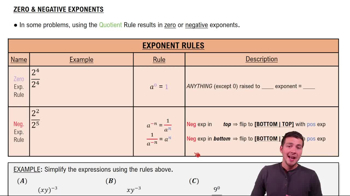
Negative Exponents

Negative exponents indicate reciprocal functions, and understanding how to differentiate them is important. For a function like (x + 1)⁻³, the derivative involves applying the power rule, which states that the derivative of xⁿ is n*xⁿ⁻¹, and then considering the negative exponent. This concept helps in simplifying and differentiating terms with negative powers in the given expression.
추천 영상:
6:37
Zero and Negative Rules