
Ch. 3 - Derivatives
Hass - Thomas' Calculus 15th Edition
Hass15th EditionThomas' CalculusISBN: 9780137616077당신이 사용하는 게 아니라요?교과서 변경
3장, 문제 3.5.33a

Find y'' if:


a. y = csc x

검증된 단계별 안내
1
First, recall that the derivative of y = csc(x) is y' = -csc(x)cot(x). This is a standard derivative that you can find in derivative tables or by using the chain rule and trigonometric identities.
Next, to find the second derivative y'', we need to differentiate y' = -csc(x)cot(x) with respect to x. This requires using the product rule, which states that if you have a function u(x)v(x), its derivative is u'(x)v(x) + u(x)v'(x).
Apply the product rule to y' = -csc(x)cot(x). Let u(x) = -csc(x) and v(x) = cot(x). Then, u'(x) = csc(x)cot(x) and v'(x) = -csc^2(x).
Substitute these derivatives into the product rule formula: y'' = u'(x)v(x) + u(x)v'(x) = [csc(x)cot(x)]cot(x) + [-csc(x)][-csc^2(x)].
Simplify the expression: y'' = csc(x)cot^2(x) + csc^3(x). This is the second derivative of y = csc(x).

비슷한 문제에 대한 검증된 영상 답변:

이 영상 해법은 위 문제에 도움이 된다고 튜터들이 추천한 것입니다.
영상 길이:
4m
도움이 되었나요?

주요 개념

질문에 올바르게 답하기 위해 반드시 이해해야 하는 핵심 개념들은 다음과 같습니다.

Second Derivative

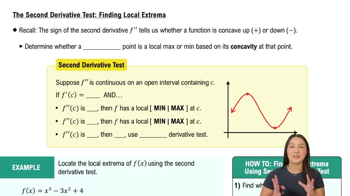
The second derivative, denoted as y'', measures the rate of change of the first derivative of a function. It provides information about the concavity of the function and can indicate points of inflection where the function changes from concave up to concave down or vice versa.
추천 영상:
06:02
The Second Derivative Test: Finding Local Extrema

Cosecant Function

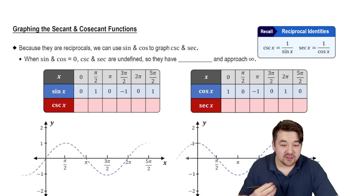
The cosecant function, denoted as csc x, is the reciprocal of the sine function, defined as csc x = 1/sin x. It is important to understand its properties, including its domain and range, as well as its behavior near asymptotes where sin x equals zero.
추천 영상:
가이드 코스
6:22
Graphs of Secant and Cosecant Functions

Differentiation Rules

Differentiation rules, such as the quotient rule and chain rule, are essential for finding derivatives of complex functions. For the cosecant function, applying the quotient rule is necessary since it can be expressed as a ratio, which simplifies the process of finding its first and second derivatives.
추천 영상:
가이드 코스
05:53
Finding Differentials
관련 실천
교과서 질문

Differentiability and Continuity on an Interval


Each figure in Exercises 45–50 shows the graph of a function over a closed interval D. At what domain points does the function appear to be


a. differentiable?


Give reasons for your answers.

150
views
교과서 질문

Quadratic approximations


a. Let Q(x) = b₀ + b₁(x − a) + b₂(x − a)² be a quadratic approximation to f(x) at x = a with these properties:


i. Q(a) = f(a)

ii. Q′(a) = f′(a)

iii. Q″(a) = f″(a).


Determine the coefficients b₀, b₁, and b₂.

168
views
교과서 질문

Interpreting Derivative Values


Effectiveness of a drug On a scale from 0 to 1, the effectiveness E of a pain-killing drug t hours after entering the bloodstream is displayed in the accompanying figure.


" style="" width="240">

a. At what times does the effectiveness appear to be increasing? What is true about the derivative at those times?

189
views
교과서 질문

Differentiability and Continuity on an Interval


Each figure in Exercises 45–50 shows the graph of a function over a closed interval D. At what domain points does the function appear to be


a. differentiable?


Give reasons for your answers.

196
views
교과서 질문

If the original 24 m edge length x of a cube decreases at the rate of 5 m/min, when x = 3 m at what rate does the cube’s

a. surface area change?

191
views
교과서 질문

Differentiability and Continuity on an Interval


Each figure in Exercises 45–50 shows the graph of a function over a closed interval D. At what domain points does the function appear to be


a. differentiable?


Give reasons for your answers.


201
views