
Ch. 3 - Derivatives
Hass - Thomas' Calculus 15th Edition
Hass15th EditionThomas' CalculusISBN: 9780137616077당신이 사용하는 게 아니라요?교과서 변경
3장, 문제 3.4.6c

Motion Along a Coordinate Line


Exercises 1–6 give the positions s = f(t) of a body moving on a coordinate line, with s in meters and t in seconds.


c. When, if ever, during the interval does the body change direction?


s = 25/(t + 5), −4 ≤ t ≤ 0

검증된 단계별 안내
1
First, understand that the body changes direction when its velocity changes sign. Velocity is the derivative of the position function with respect to time, v(t) = f'(t).
Calculate the derivative of the position function s = \(\frac{25}{t + 5}\). Use the quotient rule for derivatives, which states that if you have a function \(\frac{u}{v}\), its derivative is \(\frac{u'v - uv'}{v^2}\).
Apply the quotient rule: Let u = 25 and v = t + 5. Then, u' = 0 and v' = 1. Substitute these into the quotient rule formula to find v(t).
Simplify the expression obtained from the quotient rule to find the velocity function v(t). This will give you v(t) = \(\frac{-25}{(t + 5)^2}\).
Determine when the velocity changes sign by analyzing the expression \(\frac{-25}{(t + 5)^2}\). Since the numerator is negative and the denominator is always positive for the given interval, the velocity does not change sign, indicating the body does not change direction in the interval −4 ≤ t ≤ 0.

비슷한 문제에 대한 검증된 영상 답변:

이 영상 해법은 위 문제에 도움이 된다고 튜터들이 추천한 것입니다.
영상 길이:
3m
도움이 되었나요?

주요 개념

질문에 올바르게 답하기 위해 반드시 이해해야 하는 핵심 개념들은 다음과 같습니다.

Derivative and Velocity

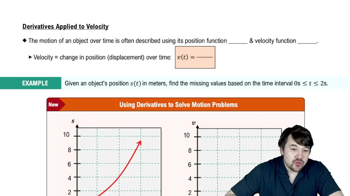
The derivative of a position function s = f(t) with respect to time t gives the velocity of the body. Velocity indicates the rate of change of position and its sign (positive or negative) shows the direction of motion. To determine when the body changes direction, we need to find when the velocity changes sign, which occurs when the derivative equals zero or is undefined.
추천 영상:
가이드 코스
06:29
Derivatives Applied To Velocity

Critical Points

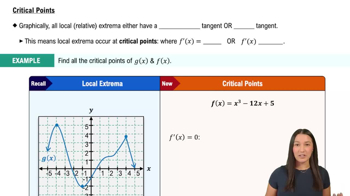
Critical points occur where the derivative of a function is zero or undefined. These points are essential in analyzing the behavior of the function, such as identifying potential changes in direction for motion problems. By evaluating the derivative of s = 25/(t + 5), we can find critical points within the interval −4 ≤ t ≤ 0 to determine when the body might change direction.
추천 영상:
04:50
Critical Points

Interval Analysis

Interval analysis involves examining the behavior of a function over a specific range of values. For motion problems, this means checking the sign of the velocity before and after critical points within the given interval. By analyzing the intervals around critical points, we can confirm if and when the body changes direction by observing changes in the sign of the velocity.
추천 영상:
02:59
Finding Area Between Curves that Cross on the Interval