

Ch. 3 - Derivatives
Hass - Thomas' Calculus 15th Edition
Hass15th EditionThomas' CalculusISBN: 9780137616077당신이 사용하는 게 아니라요?교과서 변경
3장, 문제 3.4.7c

Particle motion At time t, the position of a body moving along the s-axis is s = t³ − 6t² + 9t m.


c. Find the total distance traveled by the body from t = 0 to t = 2.

검증된 단계별 안내
1
First, find the velocity function by differentiating the position function s(t) = t³ − 6t² + 9t with respect to time t. This gives v(t) = ds/dt = 3t² - 12t + 9.
Determine the critical points where the velocity is zero or undefined, as these points may indicate changes in direction. Solve the equation 3t² - 12t + 9 = 0 to find the critical points.
Evaluate the position function s(t) at the critical points and the endpoints t = 0 and t = 2 to determine the positions of the body at these times.
Calculate the distance traveled between each pair of consecutive points by taking the absolute value of the difference in position values. This accounts for any changes in direction.
Sum the absolute distances calculated in the previous step to find the total distance traveled by the body from t = 0 to t = 2.

비슷한 문제에 대한 검증된 영상 답변:

이 영상 해법은 위 문제에 도움이 된다고 튜터들이 추천한 것입니다.
영상 길이:
7m

주요 개념

질문에 올바르게 답하기 위해 반드시 이해해야 하는 핵심 개념들은 다음과 같습니다.

Derivative

The derivative of a function represents the rate of change of the function with respect to a variable. In the context of particle motion, the derivative of the position function s(t) with respect to time t gives the velocity function v(t). This is crucial for determining when the particle changes direction, which affects the total distance traveled.
추천 영상:

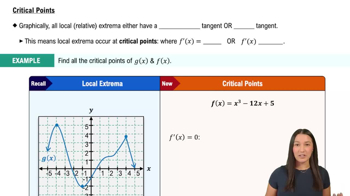
Critical Points

Critical points occur where the derivative of a function is zero or undefined. For motion along a line, these points indicate where the velocity is zero, meaning the particle changes direction. Identifying these points within the given interval helps in calculating the total distance traveled by considering the absolute value of displacement over each segment.
추천 영상:
04:50
Critical Points

Total Distance Traveled

The total distance traveled by a particle is the sum of the absolute values of its displacements over each interval where it moves in a consistent direction. This involves evaluating the position function at critical points and endpoints, ensuring that changes in direction are accounted for by summing the absolute values of each segment's displacement.
추천 영상:
가이드 코스
06:22
Introduction To Work
관련 실천
교과서 질문

Motion Along a Coordinate Line


Exercises 1–6 give the positions s = f(t) of a body moving on a coordinate line, with s in meters and t in seconds.


c. When, if ever, during the interval does the body change direction?


s = 25/(t + 5), −4 ≤ t ≤ 0

209
views
교과서 질문

Analyzing Motion Using Graphs


[Technology Exercise] Exercises 31–34 give the position function s = f(t) of an object moving along the s-axis as a function of time t. Graph f together with the velocity function v(t) = ds/dt = f'(t) and the acceleration function a(t) = d²s/dt² = f''(t). Comment on the object’s behavior in relation to the signs and values of v and a. Include in your commentary such topics as the following:


d. When does it speed up and slow down?


s = t³ - 6t² + 7t, 0 ≤ t ≤ 4

217
views
교과서 질문

Differentiability and Continuity on an Interval


Each figure in Exercises 45–50 shows the graph of a function over a closed interval D. At what domain points does the function appear to be


c. neither continuous nor differentiable?


Give reasons for your answers.


193
views
교과서 질문

Right circular cylinder The total surface area S of a right circular cylinder is related to the base radius r and height h by the equation S = 2πr² + 2πrh.


d. How is dr/dt related to dh/dt if S is constant?

246
views
교과서 질문

By computing the first few derivatives and looking for a pattern, find the following derivatives.


c. d⁷³/dx⁷³ (x sin x)

193
views
교과서 질문

Theory and Examples


In Exercises 51–54,


d. Over what intervals of x-values, if any, does the function y = f(x) increase as x increases? Decrease as x increases? How is this related to what you found in part (c)? (We will say more about this relationship in Section 4.3.)


y = x³/3

218
views