
Ch. 3 - Derivatives
Hass - Thomas' Calculus 15th Edition
Hass15th EditionThomas' CalculusISBN: 9780137616077당신이 사용하는 게 아니라요?교과서 변경
3장, 문제 3.4.8b

Particle motion At time t ≥ 0, the velocity of a body moving along the horizontal s-axis is v = t² − 4t + 3.


b. When is the body moving forward? Backward?

검증된 단계별 안내
1
To determine when the body is moving forward or backward, we need to analyze the velocity function v(t) = t² − 4t + 3.
The body is moving forward when the velocity v(t) is greater than zero, and moving backward when v(t) is less than zero.
First, find the critical points by setting the velocity function equal to zero: t² − 4t + 3 = 0. Solve this quadratic equation to find the values of t where the velocity changes sign.
Use the quadratic formula t = (-b ± √(b² - 4ac)) / 2a, where a = 1, b = -4, and c = 3, to find the roots of the equation.
Once the critical points are found, test intervals around these points to determine the sign of v(t) in each interval. This will tell you when the body is moving forward (v(t) > 0) and when it is moving backward (v(t) < 0).

비슷한 문제에 대한 검증된 영상 답변:

이 영상 해법은 위 문제에 도움이 된다고 튜터들이 추천한 것입니다.
영상 길이:
4m

주요 개념

질문에 올바르게 답하기 위해 반드시 이해해야 하는 핵심 개념들은 다음과 같습니다.

Velocity and Direction

Velocity indicates the speed and direction of a particle's motion along a path. A positive velocity means the particle is moving forward, while a negative velocity indicates backward motion. To determine when the body moves forward or backward, analyze the sign of the velocity function over time.
추천 영상:
가이드 코스
06:29
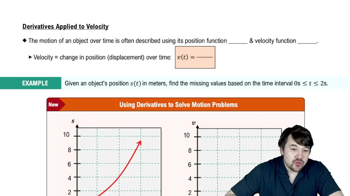
Derivatives Applied To Velocity

Quadratic Functions

The velocity function v = t² − 4t + 3 is a quadratic function, which is characterized by its parabolic graph. The roots of the quadratic equation, found using the quadratic formula, indicate the points where the velocity changes sign, helping to identify intervals of forward and backward motion.
추천 영상:
6:04
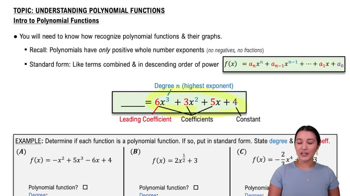
Introduction to Polynomial Functions

Solving Inequalities

To determine when the body moves forward or backward, solve the inequality v(t) > 0 for forward motion and v(t) < 0 for backward motion. This involves finding the roots of the quadratic equation and testing intervals between these roots to see where the inequality holds true.
추천 영상:
5:02
Solving Logarithmic Equations
관련 실천
교과서 질문

Analyzing Motion Using Graphs


[Technology Exercise] Exercises 31–34 give the position function s = f(t) of an object moving along the s-axis as a function of time t. Graph f together with the velocity function v(t) = ds/dt = f'(t) and the acceleration function a(t) = d²s/dt² = f''(t). Comment on the object’s behavior in relation to the signs and values of v and a. Include in your commentary such topics as the following:


b. When does it move to the left (down) or to the right (up)?


s = 200t - 16t², 0 ≤ t ≤ 12.5 (a heavy object fired straight up from Earth’s surface at 200 ft/sec)

189
views
교과서 질문

The Reciprocal Rule


b. Show that the Reciprocal Rule and the Derivative Product Rule together imply the Derivative Quotient Rule.

278
views
교과서 질문

Theory and Examples


In Exercises 51–54,


b. Graph y = f(x) and y = f'(x) side by side using separate sets of coordinate axes, and answer the following questions.


y = x⁴/4

160
views
교과서 질문

Common linear approximations at x = 0 Find the linearizations of the following functions at x = 0.


b. cos x

181
views
교과서 질문

Suppose that functions ƒ(x) and g(x) and their first derivatives have the following values at x = 0 and x = 1.


x ƒ(x) g(x) ƒ'(x) g'(x)

0 1 1 -3 1/2

1 3 5 1/2 -4


Find the first derivatives of the following combinations at the given value of x.


b. ƒ(x)g²(x), x = 0

228
views
교과서 질문

Recovering a function from its derivative


b. Repeat part (a), assuming that the graph starts at (−2, 0) instead of (−2, 3).

280
views