Ch. 3 - Derivatives
Hass - Thomas' Calculus 15th Edition
Hass15th EditionThomas' CalculusISBN: 9780137616077당신이 사용하는 게 아니라요?교과서 변경
3장, 문제 3.3.62b

The Reciprocal Rule


b. Show that the Reciprocal Rule and the Derivative Product Rule together imply the Derivative Quotient Rule.

검증된 단계별 안내
1
Start by recalling the Reciprocal Rule, which states that if you have a function \( f(x) \), the derivative of its reciprocal \( \frac{1}{f(x)} \) is given by \( -\frac{f'(x)}{(f(x))^2} \).
Next, recall the Product Rule for derivatives, which states that if you have two functions \( u(x) \) and \( v(x) \), the derivative of their product \( u(x)v(x) \) is \( u'(x)v(x) + u(x)v'(x) \).
To derive the Quotient Rule, consider a function \( \frac{u(x)}{v(x)} \). This can be rewritten as \( u(x) \cdot \frac{1}{v(x)} \).
Apply the Product Rule to \( u(x) \cdot \frac{1}{v(x)} \). Let \( u(x) \) be the first function and \( \frac{1}{v(x)} \) be the second function. The derivative is \( u'(x) \cdot \frac{1}{v(x)} + u(x) \cdot \left(-\frac{v'(x)}{(v(x))^2}\right) \).
Simplify the expression from the previous step to obtain the Quotient Rule: \( \frac{u'(x)v(x) - u(x)v'(x)}{(v(x))^2} \). This shows how the Reciprocal Rule and the Product Rule together imply the Quotient Rule.

비슷한 문제에 대한 검증된 영상 답변:

이 영상 해법은 위 문제에 도움이 된다고 튜터들이 추천한 것입니다.
영상 길이:
3m
도움이 되었나요?

주요 개념

질문에 올바르게 답하기 위해 반드시 이해해야 하는 핵심 개념들은 다음과 같습니다.

Reciprocal Rule

The Reciprocal Rule in calculus states that the derivative of the reciprocal of a function f(x), denoted as 1/f(x), is given by -f'(x)/[f(x)]^2. This rule is essential for understanding how changes in the reciprocal of a function relate to changes in the function itself, particularly when combined with other derivative rules.
추천 영상:
5:50
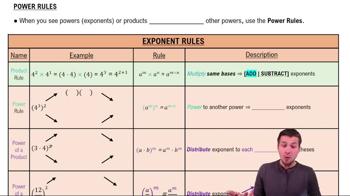
Power Rules

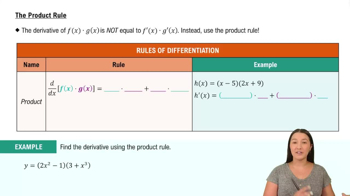
Derivative Product Rule

The Derivative Product Rule is a fundamental concept in calculus used to find the derivative of the product of two functions. If u(x) and v(x) are differentiable functions, the derivative of their product u(x)v(x) is given by u'(x)v(x) + u(x)v'(x). This rule is crucial for handling derivatives involving products of functions, which is often encountered in complex calculus problems.
추천 영상:
05:18
The Product Rule

Derivative Quotient Rule

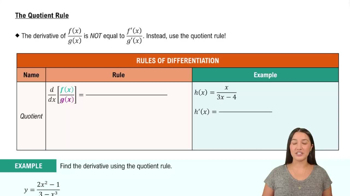
The Derivative Quotient Rule provides a method for differentiating a quotient of two functions. If u(x) and v(x) are differentiable functions, the derivative of their quotient u(x)/v(x) is given by [u'(x)v(x) - u(x)v'(x)]/[v(x)]^2. Understanding this rule is vital for solving problems involving division of functions, and it can be derived using the Reciprocal Rule and the Product Rule.
추천 영상:
06:43
The Quotient Rule
관련 실천
교과서 질문

Right circular cone The lateral surface area S of a right circular cone is related to the base radius r and height h by the equation

______

S = πrr² + .


b. How is dS/dt related to dh/dt if r is constant?

270
views

교과서 질문

Analyzing Motion Using Graphs


[Technology Exercise] Exercises 31–34 give the position function s = f(t) of an object moving along the s-axis as a function of time t. Graph f together with the velocity function v(t) = ds/dt = f'(t) and the acceleration function a(t) = d²s/dt² = f''(t). Comment on the object’s behavior in relation to the signs and values of v and a. Include in your commentary such topics as the following:


b. When does it move to the left (down) or to the right (up)?


s = 200t - 16t², 0 ≤ t ≤ 12.5 (a heavy object fired straight up from Earth’s surface at 200 ft/sec)

189
views
교과서 질문

Particle motion At time t ≥ 0, the velocity of a body moving along the horizontal s-axis is v = t² − 4t + 3.


b. When is the body moving forward? Backward?

232
views
교과서 질문

Theory and Examples


In Exercises 51–54,


b. Graph y = f(x) and y = f'(x) side by side using separate sets of coordinate axes, and answer the following questions.


y = x⁴/4

160
views
교과서 질문

Suppose that functions ƒ(x) and g(x) and their first derivatives have the following values at x = 0 and x = 1.


x ƒ(x) g(x) ƒ'(x) g'(x)

0 1 1 -3 1/2

1 3 5 1/2 -4


Find the first derivatives of the following combinations at the given value of x.


b. ƒ(x)g²(x), x = 0

228
views
교과서 질문

Recovering a function from its derivative


b. Repeat part (a), assuming that the graph starts at (−2, 0) instead of (−2, 3).

280
views