
Ch. 3 - Derivatives
Hass - Thomas' Calculus 15th Edition
Hass15th EditionThomas' CalculusISBN: 9780137616077당신이 사용하는 게 아니라요?교과서 변경
3장, 문제 3.7.46b

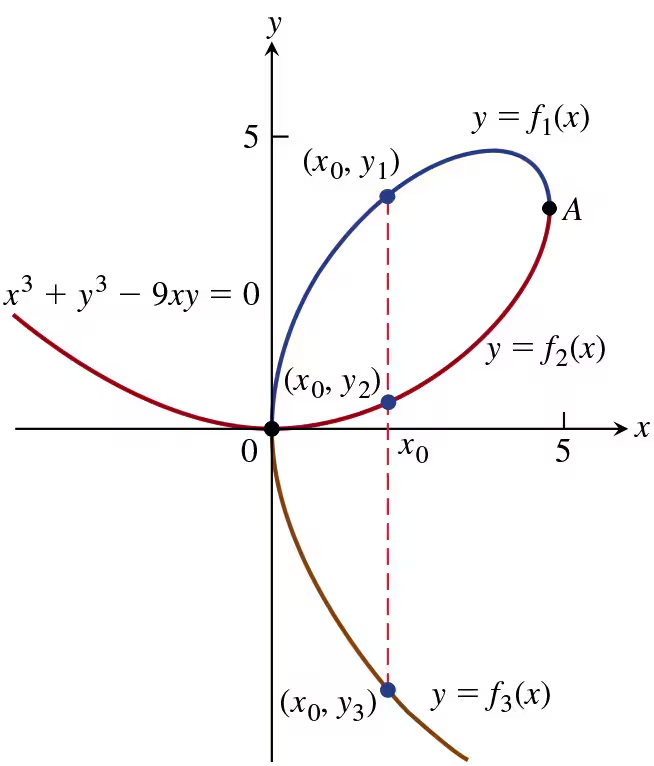
The folium of Descartes (See Figure 3.27)


b. At what point other than the origin does the folium have a horizontal tangent line?


검증된 단계별 안내
1
The folium of Descartes is given by the equation \(x^3 + y^3 - 9xy = 0\). To find where the curve has a horizontal tangent line, we need to find where the derivative \(\frac{dy}{dx} = 0\).
Implicitly differentiate the equation \(x^3 + y^3 - 9xy = 0\) with respect to \(x\). This gives \(3x^2 + 3y^2\frac{dy}{dx} - 9(y + x\frac{dy}{dx}) = 0\).
Rearrange the differentiated equation to solve for \(\frac{dy}{dx}\): \(3y^2\frac{dy}{dx} - 9x\frac{dy}{dx} = 9y - 3x^2\).
Factor out \(\frac{dy}{dx}\) to get \(\frac{dy}{dx}(3y^2 - 9x) = 9y - 3x^2\).
Set \(\frac{dy}{dx} = 0\) to find the horizontal tangent. This implies \(9y - 3x^2 = 0\), which simplifies to \(y = \frac{x^2}{3}\). Substitute \(y = \frac{x^2}{3}\) back into the original equation to find the specific point(s) other than the origin.

비슷한 문제에 대한 검증된 영상 답변:

이 영상 해법은 위 문제에 도움이 된다고 튜터들이 추천한 것입니다.
영상 길이:
9m

주요 개념

질문에 올바르게 답하기 위해 반드시 이해해야 하는 핵심 개념들은 다음과 같습니다.

Horizontal Tangent Lines

A horizontal tangent line occurs at points on a curve where the derivative of the function is zero. This means that the slope of the tangent line is flat, indicating a local maximum, minimum, or a point of inflection. To find these points, one typically sets the first derivative of the function equal to zero and solves for the variable.
추천 영상:
가이드 코스
05:13
Slopes of Tangent Lines

Implicit Differentiation

Implicit differentiation is a technique used to differentiate equations that define y implicitly in terms of x, rather than explicitly as y = f(x). This method allows us to find the derivative of y with respect to x by differentiating both sides of the equation and applying the chain rule. It is particularly useful for curves defined by equations like the folium of Descartes.
추천 영상:
가이드 코스
05:14
Finding The Implicit Derivative

Folium of Descartes

The folium of Descartes is a specific algebraic curve defined by the equation x^3 + y^3 - 9xy = 0. It has a distinctive shape and features, including points where it intersects itself and horizontal tangents. Understanding its geometry and behavior is essential for analyzing its properties, such as finding points with horizontal tangent lines.
관련 실천
교과서 질문

A sliding ladder


A 13-ft ladder is leaning against a house when its base starts to slide away. By the time the base is 12 ft from the house, the base is moving at the rate of 5 ft/sec.


b. At what rate is the area of the triangle formed by the ladder, wall, and ground changing then?


435
views
교과서 질문

Consider the function f graphed here. The domain of f is the interval [−4, 6] and its graph is made of line segments joined end to end.


" style="" width="350">


b. Graph the derivative of f. The graph should show a step function.

227
views
교과서 질문

In Exercises 47 and 48, find an equation for


(b) the horizontal tangent line to the curve at Q.


" style="" width="200">

313
views
교과서 질문

Suppose that the functions f and g and their derivatives with respect to x have the following values at x = 0 and x = 1.


" style="" width="250">


Find the derivatives with respect to x of the following combinations at the given value of x.


b. f(x)g³(x), x = 0

279
views
교과서 질문

Fruit flies (Continuation of Example 4, Section 2.1.) Populations starting out in closed environments grow slowly at first, when there are relatively few members, then more rapidly as the number of reproducing individuals increases and resources are still abundant, then slowly again as the population reaches the carrying capacity of the environment.


b. During what days does the population seem to be increasing fastest? Slowest?


240
views
교과서 질문

Hauling in a dinghy A dinghy is pulled toward a dock by a rope from the bow through a ring on the dock 6 ft above the bow. The rope is hauled in at the rate of 2 ft/sec.


b. At what rate is the angle θ changing at this instant (see the figure)?

248
views