Ch. 4 - Applications of Derivatives
Hass - Thomas' Calculus 15th Edition
Hass15th EditionThomas' CalculusISBN: 9780137616077당신이 사용하는 게 아니라요?교과서 변경
4장, 문제 103

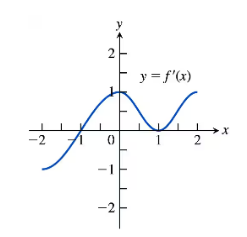
103. A function f(x) has domain (-2, 2). The graph below is a plot of the derivative of f, not a plot of f itself. In other words, this is a graph of y = f'(x). Either use this graph to determine on which intervals the graph of f is concave up and on which intervals the graph of f is concave down, or explain why this information cannot be determined from the graph.
graph

검증된 단계별 안내
1
To determine the concavity of the function f(x), we need to analyze the second derivative, f''(x). The graph provided is of the first derivative, f'(x).
The function f(x) is concave up where its second derivative, f''(x), is positive. This occurs where the graph of f'(x) is increasing.
Similarly, f(x) is concave down where its second derivative, f''(x), is negative. This occurs where the graph of f'(x) is decreasing.
From the graph, observe the intervals where f'(x) is increasing: this happens approximately from x = -2 to x = -1 and from x = 0 to x = 1. In these intervals, f(x) is concave up.
Observe the intervals where f'(x) is decreasing: this happens approximately from x = -1 to x = 0 and from x = 1 to x = 2. In these intervals, f(x) is concave down.

비슷한 문제에 대한 검증된 영상 답변:

이 영상 해법은 위 문제에 도움이 된다고 튜터들이 추천한 것입니다.
영상 길이:
2m
도움이 되었나요?

주요 개념

질문에 올바르게 답하기 위해 반드시 이해해야 하는 핵심 개념들은 다음과 같습니다.

Concavity

Concavity refers to the direction in which a curve bends. A function is concave up on an interval if its second derivative is positive, indicating that the slope of the tangent line is increasing. Conversely, a function is concave down if its second derivative is negative, meaning the slope of the tangent line is decreasing. Understanding concavity helps in analyzing the behavior of the function's graph.
추천 영상:
05:59
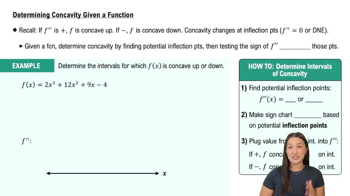
Determining Concavity Given a Function

First Derivative Test

The first derivative test involves analyzing the sign of the derivative of a function to determine where the function is increasing or decreasing. If the derivative is positive, the function is increasing; if negative, it is decreasing. This information is crucial for understanding the behavior of the function and can indirectly provide insights into its concavity when combined with the second derivative.
추천 영상:
07:09
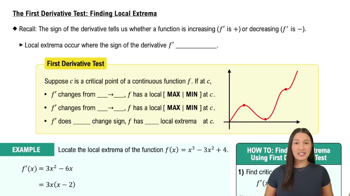
The First Derivative Test: Finding Local Extrema

Second Derivative and Its Relation to Concavity

The second derivative of a function provides information about its concavity. If the second derivative is positive, the function is concave up; if negative, it is concave down. In this question, since we are given the graph of the first derivative, we can infer concavity by examining where the first derivative is increasing or decreasing, as these changes indicate the sign of the second derivative.
추천 영상:
06:02
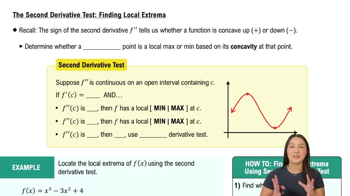
The Second Derivative Test: Finding Local Extrema
관련 실천
교과서 질문

Let ƒ(x) = 3x - x³ . Show that the equation ƒ(𝓍) = -4 has a solution in the interval [2,3] and use Newton’s method to find it.

187
views

교과서 질문

Sketch the graph of a twice-differentiable function y=f(x) that passes through the points (-2,2), (-1,1), (0,0),(1,1), and (2,2) and whose first two derivatives have the following sign patterns.

224
views
교과서 질문

In Exercises 121–124, find the inflection points (if any) on the graph of the function and the coordinates of the points on the graph where the function has a local maximum or local minimum value. Then graph the function in a region large enough to show all these points simultaneously. Add to your picture the graphs of the function’s first and second derivatives. How are the values at which these graphs intersect the x-axis related to the graph of the function? In what other ways are the graphs of the derivatives related to the graph of the function?

123. y=(4/5)x^5+16x^2-25

220
views
교과서 질문

Graph f(x) = 2x^4 -4x^2 + 1 and its first two derivatives together. Comment on the behavior of f in relation to the signs and values of f' and f".

134
views
교과서 질문

106. Motion Along a Line The graphs in Exercises 105 and 106 show the position s=f(t) of an object moving up and down on a coordinate line. At approximately what times is the (b) velocity equal to zero?

<IMAGE>

241
views
교과서 질문

Each of Exercises 89–92 shows the graphs of the first and second derivatives of a function y=f(x). Copy the picture and add to it a sketch of the approximate graph of f, given that the graph passes through the point P.

225
views