Ch. 4 - Applications of Derivatives
4์žฅ, ๋ฌธ์ œ 71

Let ฦ’(x) = 3x - xยณ . Show that the equation ฦ’(๐“) = -4 has a solution in the interval [2,3] and use Newtonโ€™s method to find it.

๊ฒ€์ฆ๋œ ๋‹จ๊ณ„๋ณ„ ์•ˆ๋‚ด
1
First, verify that the function ฦ’(x) = 3x - xยณ has a solution in the interval [2,3] by applying the Intermediate Value Theorem. Calculate ฦ’(2) and ฦ’(3) to check if there is a sign change.
Calculate ฦ’(2): ฦ’(2) = 3(2) - (2)ยณ = 6 - 8 = -2. Calculate ฦ’(3): ฦ’(3) = 3(3) - (3)ยณ = 9 - 27 = -18. Since ฦ’(2) = -2 and ฦ’(3) = -18, there is no sign change, so check the values of ฦ’(x) at the endpoints to ensure a solution exists.
Since the function is continuous and ฦ’(2) = -2 and ฦ’(3) = -18, check if the value -4 lies between these two values. Since -4 is between -2 and -18, by the Intermediate Value Theorem, there is at least one solution in the interval [2,3].
To apply Newton's method, start with an initial guess xโ‚€ within the interval [2,3]. A reasonable choice is xโ‚€ = 2.5. Newton's method formula is xโ‚™โ‚Šโ‚ = xโ‚™ - ฦ’(xโ‚™)/ฦ’'(xโ‚™).
Find the derivative ฦ’'(x) = 3 - 3xยฒ. Use this derivative in the Newton's method formula: xโ‚™โ‚Šโ‚ = xโ‚™ - (3xโ‚™ - xโ‚™ยณ + 4)/(3 - 3xโ‚™ยฒ). Substitute xโ‚€ = 2.5 into this formula to find the next approximation xโ‚.

๋น„์Šทํ•œ ๋ฌธ์ œ์— ๋Œ€ํ•œ ๊ฒ€์ฆ๋œ ์˜์ƒ ๋‹ต๋ณ€:

์ด ์˜์ƒ ํ•ด๋ฒ•์€ ์œ„ ๋ฌธ์ œ์— ๋„์›€์ด ๋œ๋‹ค๊ณ  ํŠœํ„ฐ๋“ค์ด ์ถ”์ฒœํ•œ ๊ฒƒ์ž…๋‹ˆ๋‹ค.
์˜์ƒ ๊ธธ์ด:
11m
๋„์›€์ด ๋˜์—ˆ๋‚˜์š”?

์ฃผ์š” ๊ฐœ๋…

์งˆ๋ฌธ์— ์˜ฌ๋ฐ”๋ฅด๊ฒŒ ๋‹ตํ•˜๊ธฐ ์œ„ํ•ด ๋ฐ˜๋“œ์‹œ ์ดํ•ดํ•ด์•ผ ํ•˜๋Š” ํ•ต์‹ฌ ๊ฐœ๋…๋“ค์€ ๋‹ค์Œ๊ณผ ๊ฐ™์Šต๋‹ˆ๋‹ค.

Intermediate Value Theorem

The Intermediate Value Theorem states that if a continuous function takes on two values at two points, it must take on every value between those two points at least once. In this case, we can evaluate ฦ’(2) and ฦ’(3) to show that the function changes sign over the interval [2,3], indicating that there is at least one solution to the equation ฦ’(๐“) = -4 within that interval.
์ถ”์ฒœ ์˜์ƒ:
๊ฐ€์ด๋“œ ์ฝ”์Šค
06:11
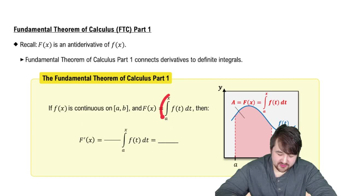
Fundamental Theorem of Calculus Part 1

Newton's Method

Newton's Method is an iterative numerical technique used to find approximate solutions to equations. It starts with an initial guess and refines it using the formula x_{n+1} = x_n - ฦ’(x_n)/ฦ’'(x_n), where ฦ’' is the derivative of ฦ’. This method is particularly effective for finding roots of functions when the derivative is known and can lead to rapid convergence to the actual solution.
์ถ”์ฒœ ์˜์ƒ:

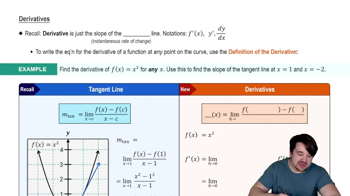
Derivatives

The derivative of a function measures how the function's output changes as its input changes. It is a fundamental concept in calculus that provides information about the function's slope and behavior. For Newton's Method, calculating the derivative of ฦ’(x) is essential, as it is used to determine the slope at the current approximation, guiding the next guess towards the root.
์ถ”์ฒœ ์˜์ƒ:
๊ด€๋ จ ์‹ค์ฒœ
๊ต๊ณผ์„œ ์งˆ๋ฌธ

Sketch the graph of a twice-differentiable function y=f(x) that passes through the points (-2,2), (-1,1), (0,0),(1,1), and (2,2) and whose first two derivatives have the following sign patterns.

224
views

๊ต๊ณผ์„œ ์งˆ๋ฌธ

The ladder problem What is the approximate length (in feet) of the longest ladder you can carry horizontally around the corner of the corridor shown here? Round your answer down to the nearest foot.

367
views
๊ต๊ณผ์„œ ์งˆ๋ฌธ

Theory and Examples


Sketch the graph of a differentiable function y = f(x) that has a local minima at (1, 1) and (3, 3).

212
views
๊ต๊ณผ์„œ ์งˆ๋ฌธ

103. A function f(x) has domain (-2, 2). The graph below is a plot of the derivative of f, not a plot of f itself. In other words, this is a graph of y = f'(x). Either use this graph to determine on which intervals the graph of f is concave up and on which intervals the graph of f is concave down, or explain why this information cannot be determined from the graph.

256
views
๊ต๊ณผ์„œ ์งˆ๋ฌธ

Theory and Examples


Sketch the graph of a differentiable function y = f(x) that has a local maxima at (1, 1) and (3, 3)

204
views
๊ต๊ณผ์„œ ์งˆ๋ฌธ

Each of Exercises 89โ€“92 shows the graphs of the first and second derivatives of a function y=f(x). Copy the picture and add to it a sketch of the approximate graph of f, given that the graph passes through the point P.

225
views