Ch. 4 - Applications of Derivatives
Hass - Thomas' Calculus 15th Edition
Hass15th EditionThomas' CalculusISBN: 9780137616077당신이 사용하는 게 아니라요?교과서 변경
4장, 문제 4.5.56

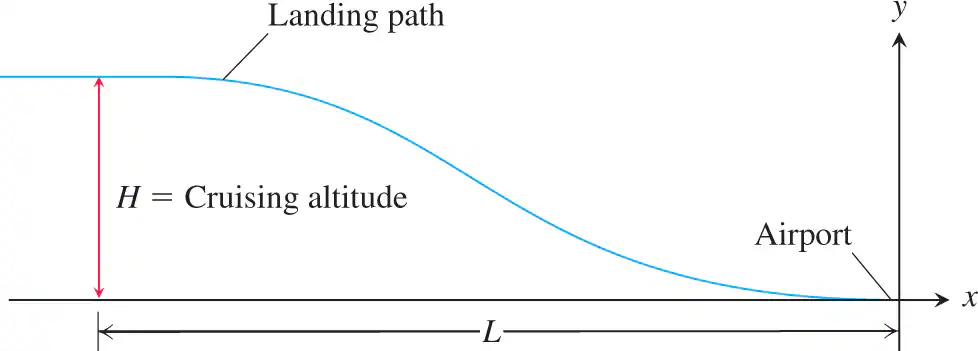
56. Airplane landing path An airplane is flying at altitude H when it begins its descent to an airport runway that is at horizontal ground distance L from the airplane, as shown in the accompanying figure. Assume that the landing path of the airplane is the graph of a cubic polynomial function y = ax^3+bx^2+cx+d, where y(-L)= H and y(0)=0.
a. What is dy/dx at x = 0?
b. What is dy/dx at x = -L?
c. Use the values for dy/dx at x = 0 and x =- L together with y(0) = 0 and y(-L) = H to show that y(x)=H[2(x/L)^3+3(x/L)^2]

검증된 단계별 안내
1
Step 1: Begin by understanding the problem. The airplane's landing path is modeled by a cubic polynomial function y = ax^3 + bx^2 + cx + d. The given conditions are y(-L) = H (altitude at horizontal distance -L) and y(0) = 0 (altitude at the airport). Additionally, dy/dx at x = 0 and x = -L are required to derive the specific form of the polynomial.
Step 2: To find dy/dx at x = 0, differentiate the polynomial y = ax^3 + bx^2 + cx + d with respect to x. The derivative is dy/dx = 3ax^2 + 2bx + c. Substitute x = 0 into this derivative to find dy/dx at x = 0, which simplifies to c.
Step 3: To find dy/dx at x = -L, use the same derivative dy/dx = 3ax^2 + 2bx + c. Substitute x = -L into this derivative to find dy/dx at x = -L, which simplifies to 3a(-L)^2 + 2b(-L) + c.
Step 4: Use the boundary conditions y(-L) = H and y(0) = 0 to solve for d and relate the coefficients a, b, c, and d. Substituting x = -L into y = ax^3 + bx^2 + cx + d gives H = a(-L)^3 + b(-L)^2 + c(-L) + d. Substituting x = 0 into y = ax^3 + bx^2 + cx + d gives 0 = d.
Step 5: Combine the results for dy/dx at x = 0 and x = -L, along with the boundary conditions y(-L) = H and y(0) = 0, to derive the specific form of the polynomial. After simplification, the landing path is shown to be y(x) = H[2(x/L)^3 + 3(x/L)^2].

비슷한 문제에 대한 검증된 영상 답변:

이 영상 해법은 위 문제에 도움이 된다고 튜터들이 추천한 것입니다.
영상 길이:
9m
도움이 되었나요?

주요 개념

질문에 올바르게 답하기 위해 반드시 이해해야 하는 핵심 개념들은 다음과 같습니다.

Cubic Polynomial Functions

A cubic polynomial function is a mathematical expression of the form y = ax^3 + bx^2 + cx + d, where a, b, c, and d are constants. This type of function can model various real-world scenarios, including the trajectory of an airplane during landing. Understanding the properties of cubic functions, such as their shape and critical points, is essential for analyzing the landing path described in the question.
추천 영상:
6:04
Introduction to Polynomial Functions

Derivative and Slope

The derivative of a function, denoted as dy/dx, represents the slope of the tangent line to the curve at a given point. In the context of the airplane's landing path, calculating dy/dx at specific points (x = 0 and x = -L) provides insight into the rate of change of altitude as the airplane descends. This information is crucial for understanding the airplane's approach angle and descent rate.
추천 영상:
05:45
Understanding Slope Fields

Boundary Conditions

Boundary conditions are specific values that a function must satisfy at certain points. In this problem, the conditions y(-L) = H and y(0) = 0 define the altitude of the airplane at the start and end of its descent. These conditions are essential for determining the coefficients of the cubic polynomial and for deriving the final expression for y(x), ensuring that the function accurately represents the airplane's landing path.
추천 영상:
가이드 코스
02:59
Piecewise Functions Example 1