Ch. 4 - Applications of Derivatives
Hass - Thomas' Calculus 15th Edition
Hass15th EditionThomas' CalculusISBN: 9780137616077당신이 사용하는 게 아니라요?교과서 변경
4장, 문제 4.7.60

Checking Antiderivative Formulas


Verify the formulas in Exercises 57–62 by differentiation.


∫csc²((x − 1)/3)dx = −3cot((x − 1)/3) + C

검증된 단계별 안내
1
Identify the given antiderivative formula: \(\int \csc^{2}\left(\frac{x - 1}{3}\right) \, dx = -3 \cot\left(\frac{x - 1}{3}\right) + C\).
Recall that to verify an antiderivative, you differentiate the right-hand side and check if you get the original integrand.
Differentiate the function \(-3 \cot\left(\frac{x - 1}{3}\right)\) using the chain rule. Start by differentiating \(\cot(u)\) where \(u = \frac{x - 1}{3}\).
Use the derivative formula \(\frac{d}{du} \cot(u) = -\csc^{2}(u)\), so \(\frac{d}{dx} \cot\left(\frac{x - 1}{3}\right) = -\csc^{2}\left(\frac{x - 1}{3}\right) \cdot \frac{d}{dx} \left(\frac{x - 1}{3}\right)\).
Calculate \(\frac{d}{dx} \left(\frac{x - 1}{3}\right) = \frac{1}{3}\), then multiply all parts together and simplify to confirm the derivative equals \(\csc^{2}\left(\frac{x - 1}{3}\right)\), which verifies the formula.

비슷한 문제에 대한 검증된 영상 답변:

이 영상 해법은 위 문제에 도움이 된다고 튜터들이 추천한 것입니다.
영상 길이:
3m
도움이 되었나요?

주요 개념

질문에 올바르게 답하기 위해 반드시 이해해야 하는 핵심 개념들은 다음과 같습니다.

Antiderivatives and Indefinite Integrals

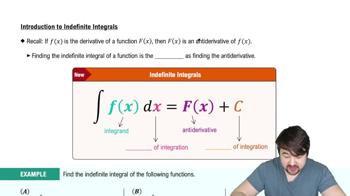
An antiderivative of a function is another function whose derivative equals the original function. Indefinite integrals represent the family of all antiderivatives and include a constant of integration, C, since differentiation of a constant is zero.
추천 영상:
가이드 코스
05:04
Introduction to Indefinite Integrals

Differentiation of Composite Functions (Chain Rule)

The chain rule is used to differentiate composite functions, where one function is inside another. It states that the derivative of f(g(x)) is f'(g(x)) multiplied by g'(x). This is essential when verifying antiderivatives involving expressions like (x - 1)/3.
추천 영상:
03:58
The Chain Rule for 3+ Functions

Derivatives of Trigonometric Functions

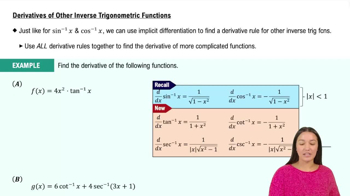
Knowing the derivatives of basic trig functions like cotangent and cosecant squared is crucial. For example, the derivative of cot(u) is -csc²(u) times the derivative of u. This knowledge helps verify if the given antiderivative formula is correct by differentiation.
추천 영상:
06:35
Derivatives of Other Inverse Trigonometric Functions
관련 실천
교과서 질문

Sketch the graphs of the rational functions in Exercises 53–60.


𝓍²

y = ------------------

𝓍² ― 4

261
views

교과서 질문

Checking the Mean Value Theorem


Which of the functions in Exercises 7–12 satisfy the hypotheses of the Mean Value Theorem on the given interval, and which do not? Give reasons for your answers.


f(x) = {x² − x, −2 ≤ x ≤−1

2x² − 3x − 3, −1 < x ≤ 0

218
views
교과서 질문

56. Airplane landing path An airplane is flying at altitude H when it begins its descent to an airport runway that is at horizontal ground distance L from the airplane, as shown in the accompanying figure. Assume that the landing path of the airplane is the graph of a cubic polynomial function y = ax^3+bx^2+cx+d, where y(-L)= H and y(0)=0.

a. What is dy/dx at x = 0?

b. What is dy/dx at x = -L?

c. Use the values for dy/dx at x = 0 and x =- L together with y(0) = 0 and y(-L) = H to show that y(x)=H[2(x/L)^3+3(x/L)^2]

158
views
교과서 질문

Absolute Extrema on Finite Closed Intervals


In Exercises 21–36, find the absolute maximum and minimum values of each function on the given interval. Then graph the function. Identify the points on the graph where the absolute extrema occur, and include their coordinates.


g(x) = √(4 − x²), −2 ≤ x ≤ 1

305
views
교과서 질문

The 8-ft wall shown here stands 27 ft from the building. Find the length of the shortest straight beam that will reach to the side of the building from the ground outside the wall.

211
views
교과서 질문

Finding Indefinite Integrals


In Exercises 17–56, find the most general antiderivative or indefinite integral. You may need to try a solution and then adjust your guess. Check your answers by differentiation.


∫2x(1 − x⁻³) dx

30
views