
Ch. 4 - Applications of Derivatives
Hass - Thomas' Calculus 15th Edition
Hass15th EditionThomas' CalculusISBN: 9780137616077당신이 사용하는 게 아니라요?교과서 변경
4장, 문제 4.7.13c

Finding Antiderivatives
In Exercises 1–16, find an antiderivative for each function. Do as many as you can mentally. Check your answers by differentiation.
-sec²(3x/2)

검증된 단계별 안내
1
Recognize that the function given is \(-\sec^{2}\left(\frac{3x}{2}\right)\), which resembles the derivative of the tangent function, since \(\frac{d}{dx}[\tan(u)] = \sec^{2}(u) \cdot \frac{du}{dx}\).
Identify the inner function \(u = \frac{3x}{2}\) and compute its derivative: \(\frac{du}{dx} = \frac{3}{2}\).
Set up the antiderivative integral: \(\int -\sec^{2}\left(\frac{3x}{2}\right) dx\).
Use substitution: let \(u = \frac{3x}{2}\), so \(dx = \frac{2}{3} du\). Rewrite the integral in terms of \(u\): \(\int -\sec^{2}(u) \cdot \frac{2}{3} du = -\frac{2}{3} \int \sec^{2}(u) du\).
Recall that \(\int \sec^{2}(u) du = \tan(u) + C\), so the antiderivative is \(-\frac{2}{3} \tan\left(\frac{3x}{2}\right) + C\).

비슷한 문제에 대한 검증된 영상 답변:

이 영상 해법은 위 문제에 도움이 된다고 튜터들이 추천한 것입니다.
영상 길이:
3m
도움이 되었나요?

주요 개념

질문에 올바르게 답하기 위해 반드시 이해해야 하는 핵심 개념들은 다음과 같습니다.

Antiderivative (Indefinite Integral)

An antiderivative of a function is another function whose derivative equals the original function. It is also called the indefinite integral and includes a constant of integration since differentiation loses constant terms.
추천 영상:
가이드 코스
05:04
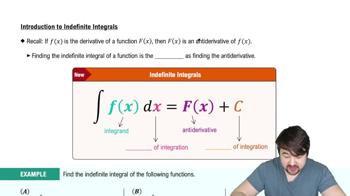
Introduction to Indefinite Integrals

Derivative of Trigonometric Functions

Knowing the derivatives of basic trig functions like tan(x) and sec(x) is essential. For example, the derivative of tan(x) is sec²(x), which helps in recognizing antiderivatives involving sec² terms.
추천 영상:
06:35
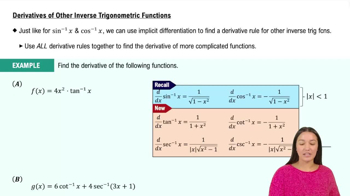
Derivatives of Other Inverse Trigonometric Functions

Chain Rule and Substitution

When functions involve compositions like sec²(3x/2), the chain rule applies. To find antiderivatives, substitution reverses the chain rule by adjusting for the inner function's derivative.
추천 영상:
05:02
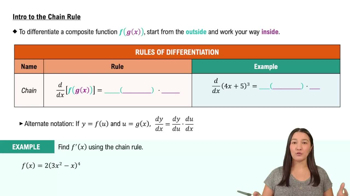
Intro to the Chain Rule
관련 실천
교과서 질문

Identifying Extrema


In Exercises 63 and 64, the graph of f' is given. Assume that f has domain (-2, 2).


" style="max-width: 100%; white-space-collapse: preserve;" width="190">


b. Either use the graph to determine which intervals f is positive on and which intervals f is negative on, or explain why this information cannot be determined from the graph.

231
views
교과서 질문

Theory and Examples


Sketch the graph of a differentiable function y = f(x) that has a local maximum at (1, 1) and a local minimum at (3, 3).

217
views
교과서 질문

Analyzing Functions from Derivatives


Answer the following questions about the functions whose derivatives are given in Exercises 1–14:


b. On what open intervals is f increasing or decreasing?


f′(x) = (x − 1)(x + 2)(x − 3)

209
views
교과서 질문

Finding displacement from an antiderivative of velocity

a. Suppose that the velocity of a body moving along the s-axis is

ds/dt = v = 9.8t − 3.

iii. Now find the body’s displacement from t = 1 to t = 3 given that s = s₀ when t = 0.

29
views
교과서 질문

[Technology Exercises] When solving Exercises 14–30, you may need to use appropriate technology (such as a calculator or a computer).

27. Converging to different zeros Use Newton's method to find the zeros of f(x)=4x^4-4x^2 using the given starting values.

c. x_0 = 0.8 and x_0 = 2, lying in (√2/2, ∞)

104
views
교과서 질문

Analyzing Functions from Derivatives


Answer the following questions about the functions whose derivatives are given in Exercises 1–14:

c. At what points, if any, does f assume local maximum or minimum values?


f′(x) = (x − 1)(x + 2)(x − 3)

256
views