
Ch. 4 - Applications of Derivatives
Hass - Thomas' Calculus 15th Edition
Hass15th EditionThomas' CalculusISBN: 9780137616077당신이 사용하는 게 아니라요?교과서 변경
4장, 문제 4.3.68b

Theory and Examples


Sketch the graph of a differentiable function y = f(x) that has a local maximum at (1, 1) and a local minimum at (3, 3).

검증된 단계별 안내
1
Start by understanding the characteristics of a differentiable function. A differentiable function is smooth and has no sharp corners or discontinuities. This means the function has a derivative at every point in its domain.
Identify the points where the local maximum and minimum occur. The problem states that there is a local maximum at (1, 1) and a local minimum at (3, 3). At these points, the derivative of the function will be zero, indicating horizontal tangents.
Consider the behavior of the function around the local maximum at (1, 1). As x approaches 1 from the left, the function should be increasing, and as x moves past 1 to the right, the function should be decreasing. This creates a peak at x = 1.
Similarly, analyze the behavior around the local minimum at (3, 3). As x approaches 3 from the left, the function should be decreasing, and as x moves past 3 to the right, the function should be increasing. This creates a trough at x = 3.
Sketch the graph by connecting these points smoothly, ensuring the function increases towards the local maximum, decreases after it, and then decreases towards the local minimum, increasing after it. The graph should reflect the smooth transition between these critical points, maintaining differentiability.

비슷한 문제에 대한 검증된 영상 답변:

이 영상 해법은 위 문제에 도움이 된다고 튜터들이 추천한 것입니다.
영상 길이:
6m
도움이 되었나요?

주요 개념

질문에 올바르게 답하기 위해 반드시 이해해야 하는 핵심 개념들은 다음과 같습니다.

Differentiable Function

A differentiable function is one that has a derivative at every point in its domain. This implies the function is smooth and continuous, without any sharp corners or discontinuities. Understanding differentiability is crucial for sketching graphs, as it ensures the function's behavior can be predicted using its derivative.
추천 영상:
가이드 코스
05:53
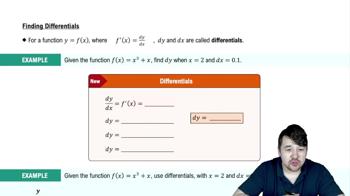
Finding Differentials

Local Maximum

A local maximum occurs at a point where the function value is greater than or equal to the values of the function at nearby points. At a local maximum, the derivative changes from positive to negative, indicating a peak in the graph. Recognizing local maxima helps in identifying the turning points of the function.
추천 영상:
06:02
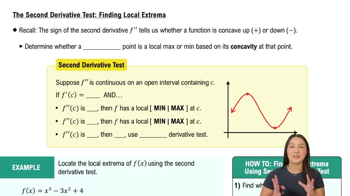
The Second Derivative Test: Finding Local Extrema

Local Minimum

A local minimum is a point where the function value is less than or equal to the values of the function at nearby points. At a local minimum, the derivative changes from negative to positive, indicating a trough in the graph. Identifying local minima is essential for understanding the function's valleys and overall shape.
추천 영상:
06:02
The Second Derivative Test: Finding Local Extrema
관련 실천
교과서 질문

Identifying Extrema


In Exercises 63 and 64, the graph of f' is given. Assume that f has domain (-2, 2).


" style="max-width: 100%; white-space-collapse: preserve;" width="190">


b. Either use the graph to determine which intervals f is positive on and which intervals f is negative on, or explain why this information cannot be determined from the graph.

231
views
교과서 질문

Finding Antiderivatives

In Exercises 1–16, find an antiderivative for each function. Do as many as you can mentally. Check your answers by differentiation.

-sec²(3x/2)

31
views
교과서 질문

Theory and Examples


In Exercises 51 and 52, give reasons for your answers.


Let f(x) = |x³ − 9x|.


b. Does f'(3) exist?

162
views
교과서 질문

Analyzing Functions from Derivatives


Answer the following questions about the functions whose derivatives are given in Exercises 1–14:


b. On what open intervals is f increasing or decreasing?


f′(x) = (x − 1)(x + 2)(x − 3)

209
views
교과서 질문

Finding displacement from an antiderivative of velocity

a. Suppose that the velocity of a body moving along the s-axis is

ds/dt = v = 9.8t − 3.

iii. Now find the body’s displacement from t = 1 to t = 3 given that s = s₀ when t = 0.

29
views
교과서 질문

[Technology Exercises] When solving Exercises 14–30, you may need to use appropriate technology (such as a calculator or a computer).

27. Converging to different zeros Use Newton's method to find the zeros of f(x)=4x^4-4x^2 using the given starting values.

c. x_0 = 0.8 and x_0 = 2, lying in (√2/2, ∞)

104
views