
Ch. 4 - Applications of Derivatives
Hass - Thomas' Calculus 15th Edition
Hass15th EditionThomas' CalculusISBN: 9780137616077당신이 사용하는 게 아니라요?교과서 변경
4장, 문제 45

Finding Position from Velocity or Acceleration


Exercises 45–48 give the acceleration a=d²s/dt², initial velocity, and initial position of an object moving on a coordinate line. Find the object’s position at time t.


a = 32, v(0) = 20, s(0) = 5

검증된 단계별 안내
1
Start by integrating the acceleration function a(t) = 32 with respect to time t to find the velocity function v(t). This involves finding the antiderivative of 32.
The antiderivative of a constant 32 is 32t plus a constant of integration, C1. So, v(t) = 32t + C1.
Use the initial condition v(0) = 20 to solve for C1. Substitute t = 0 and v(0) = 20 into the velocity equation: 20 = 32(0) + C1, which gives C1 = 20.
Now, integrate the velocity function v(t) = 32t + 20 with respect to time t to find the position function s(t). This involves finding the antiderivative of 32t + 20.
The antiderivative of 32t is 16t² and the antiderivative of 20 is 20t. So, s(t) = 16t² + 20t + C2. Use the initial condition s(0) = 5 to solve for C2 by substituting t = 0 and s(0) = 5 into the position equation: 5 = 16(0)² + 20(0) + C2, which gives C2 = 5. Thus, the position function is s(t) = 16t² + 20t + 5.

비슷한 문제에 대한 검증된 영상 답변:

이 영상 해법은 위 문제에 도움이 된다고 튜터들이 추천한 것입니다.
영상 길이:
6m
도움이 되었나요?

주요 개념

질문에 올바르게 답하기 위해 반드시 이해해야 하는 핵심 개념들은 다음과 같습니다.

Integration

Integration is the process of finding the antiderivative or the area under a curve. In this context, it is used to find the velocity function from the acceleration function by integrating acceleration with respect to time. This step is crucial for determining the velocity at any given time.
추천 영상:
가이드 코스
05:04
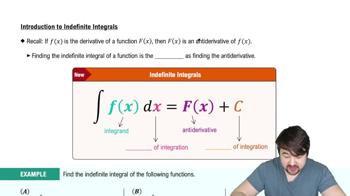
Introduction to Indefinite Integrals

Initial Conditions

Initial conditions are values given at the start of a problem that help determine the specific solution to a differential equation. Here, the initial velocity v(0) = 20 and initial position s(0) = 5 are used to find the constants of integration when solving for velocity and position functions.
추천 영상:
가이드 코스
05:03
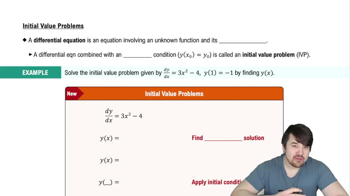
Initial Value Problems

Position Function

The position function s(t) describes the location of an object at any time t. It is found by integrating the velocity function, which itself is derived from the acceleration function. Using the initial conditions, we can solve for any constants and determine the exact position function for the object.
추천 영상:
가이드 코스
5:20
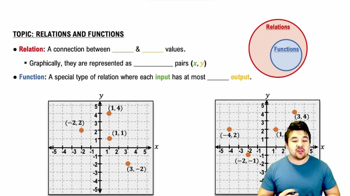
Relations and Functions
관련 실천
교과서 질문

Each of Exercises 43–48 gives the first derivative of a function y = ƒ(𝓍). (a) At what points, if any, does the graph of ƒ have a local maximum, local minimum, or inflection point? (b) Sketch the general shape of the graph.

y' = 𝓍⁴ ― 2𝓍² 

213
views
교과서 질문

The range R of a projectile fired from the origin over horizontal ground is the distance from the origin to the point of impact. If the projectile is fired with an initial velocity at an angle with the horizontal, then in Chapter 13 we find that R-v_0^2/g(sin 2α) where g is the downward acceleration due to gravity. Find the angle α for which the range R is the largest possible.

242
views
교과서 질문

Finding Position from Velocity or Acceleration


Exercises 41–44 give the velocity v = ds/dt and initial position of an object moving along a coordinate line. Find the object’s position at time t.


v = sin πt, s(0) = 0

342
views
교과서 질문

In Exercises 9–66, graph the function using appropriate methods from the graphing procedures presented just before Example 9, identifying the coordinates of any local extreme points and inflection points. Then find coordinates of absolute extreme points, if any.

46. y = cos(x) + √3 * sin(x), 0 ≤ x ≤ 2π

175
views
교과서 질문

Each of Exercises 43–48 gives the first derivative of a function y = ƒ(𝓍). (a) At what points, if any, does the graph of ƒ have a local maximum, local minimum, or inflection point? (b) Sketch the general shape of the graph.

y' = 𝓍² ― 𝓍―6

255
views
교과서 질문

Graphs and Graphing


Graph the curves in Exercises 33–42.

______

y = 𝓍√4 ― 𝓍²

175
views