

Ch. 4 - Applications of Derivatives
Hass - Thomas' Calculus 15th Edition
Hass15th EditionThomas' CalculusISBN: 9780137616077당신이 사용하는 게 아니라요?교과서 변경
4장, 문제 46

In Exercises 9–66, graph the function using appropriate methods from the graphing procedures presented just before Example 9, identifying the coordinates of any local extreme points and inflection points. Then find coordinates of absolute extreme points, if any.
46. y = cos(x) + √3 * sin(x), 0 ≤ x ≤ 2π

검증된 단계별 안내
1
Step 1: Begin by identifying the function y = cos(x) + √3 * sin(x). This is a combination of trigonometric functions, which suggests that the graph will be periodic. The period of both cos(x) and sin(x) is 2π, so the function will repeat every 2π.
Step 2: To find local extreme points, calculate the derivative of the function. The derivative y' = -sin(x) + √3 * cos(x). Set y' = 0 to find critical points, which are potential local extrema.
Step 3: Solve the equation -sin(x) + √3 * cos(x) = 0 for x within the interval [0, 2π]. This can be rewritten as tan(x) = √3, which gives the critical points. Use these points to determine the local maxima and minima by evaluating the second derivative or using the first derivative test.
Step 4: To find inflection points, calculate the second derivative y'' = -cos(x) - √3 * sin(x). Set y'' = 0 and solve for x to find points where the concavity changes, indicating inflection points.
Step 5: Evaluate the function at the endpoints x = 0 and x = 2π to find absolute extreme points. Compare these values with the values at the local extrema to determine the absolute maximum and minimum within the given interval.

비슷한 문제에 대한 검증된 영상 답변:

이 영상 해법은 위 문제에 도움이 된다고 튜터들이 추천한 것입니다.
영상 길이:
12m
도움이 되었나요?

주요 개념

질문에 올바르게 답하기 위해 반드시 이해해야 하는 핵심 개념들은 다음과 같습니다.

Graphing Trigonometric Functions

Graphing trigonometric functions involves understanding their periodic nature and key features such as amplitude, period, and phase shift. For the function y = cos(x) + √3 * sin(x), it is essential to recognize how the cosine and sine components combine to form a new wave, which can be graphed over the interval from 0 to 2π.
추천 영상:
가이드 코스
6:04
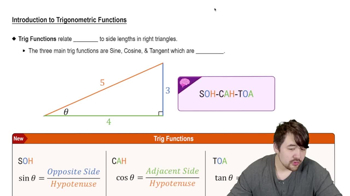
Introduction to Trigonometric Functions

Local Extreme Points

Local extreme points are the points on a graph where the function reaches a local maximum or minimum. To find these points, one typically takes the derivative of the function, sets it to zero, and solves for x. The resulting x-values can then be evaluated in the original function to find the corresponding y-values.
추천 영상:
04:50
Critical Points

Inflection Points

Inflection points occur where the concavity of the function changes, which can be determined by analyzing the second derivative. If the second derivative changes sign at a point, that point is an inflection point. Identifying these points helps in understanding the overall shape of the graph and the behavior of the function.
추천 영상:
04:50
Critical Points
관련 실천
교과서 질문

Each of Exercises 43–48 gives the first derivative of a function y = ƒ(𝓍). (a) At what points, if any, does the graph of ƒ have a local maximum, local minimum, or inflection point? (b) Sketch the general shape of the graph.

y' = 𝓍⁴ ― 2𝓍² 

213
views
교과서 질문

The range R of a projectile fired from the origin over horizontal ground is the distance from the origin to the point of impact. If the projectile is fired with an initial velocity at an angle with the horizontal, then in Chapter 13 we find that R-v_0^2/g(sin 2α) where g is the downward acceleration due to gravity. Find the angle α for which the range R is the largest possible.

242
views
교과서 질문

Finding Position from Velocity or Acceleration


Exercises 41–44 give the velocity v = ds/dt and initial position of an object moving along a coordinate line. Find the object’s position at time t.


v = sin πt, s(0) = 0

342
views
교과서 질문

In Exercises 49–52, graph each function. Then use the function’s first derivative to explain what you see.

y = 𝓍²/³ + (𝓍―1)²/³ 

207
views
교과서 질문

Each of Exercises 43–48 gives the first derivative of a function y = ƒ(𝓍). (a) At what points, if any, does the graph of ƒ have a local maximum, local minimum, or inflection point? (b) Sketch the general shape of the graph.

y' = 𝓍² ― 𝓍―6

255
views
교과서 질문

Finding Position from Velocity or Acceleration


Exercises 45–48 give the acceleration a=d²s/dt², initial velocity, and initial position of an object moving on a coordinate line. Find the object’s position at time t.


a = 32, v(0) = 20, s(0) = 5

222
views