
Ch. 4 - Applications of Derivatives
Hass - Thomas' Calculus 15th Edition
Hass15th EditionThomas' CalculusISBN: 9780137616077당신이 사용하는 게 아니라요?교과서 변경
4장, 문제 4.3.37

Identifying Extrema


In Exercises 19–40:


a. Find the open intervals on which the function is increasing and those on which it is decreasing.


b. Identify the function’s local extreme values, if any, saying where they occur.


f(x) = x¹ᐟ³(x + 8)

검증된 단계별 안내
1
To determine where the function \( f(x) = x^{1/3}(x + 8) \) is increasing or decreasing, first find its derivative \( f'(x) \). Use the product rule: if \( u(x) = x^{1/3} \) and \( v(x) = x + 8 \), then \( f'(x) = u'(x)v(x) + u(x)v'(x) \).
Calculate \( u'(x) \) and \( v'(x) \). For \( u(x) = x^{1/3} \), use the power rule to find \( u'(x) = \frac{1}{3}x^{-2/3} \). For \( v(x) = x + 8 \), \( v'(x) = 1 \).
Substitute \( u'(x) \), \( v(x) \), \( u(x) \), and \( v'(x) \) into the product rule formula: \( f'(x) = \frac{1}{3}x^{-2/3}(x + 8) + x^{1/3}(1) \). Simplify this expression to find \( f'(x) \).
Find the critical points by setting \( f'(x) = 0 \) and solving for \( x \). These points, along with any points where \( f'(x) \) is undefined, will help determine intervals of increase and decrease.
Analyze the sign of \( f'(x) \) on the intervals determined by the critical points. If \( f'(x) > 0 \), the function is increasing on that interval; if \( f'(x) < 0 \), it is decreasing. Use this information to identify any local extrema by checking the sign changes of \( f'(x) \).

비슷한 문제에 대한 검증된 영상 답변:

이 영상 해법은 위 문제에 도움이 된다고 튜터들이 추천한 것입니다.
영상 길이:
7m
도움이 되었나요?

주요 개념

질문에 올바르게 답하기 위해 반드시 이해해야 하는 핵심 개념들은 다음과 같습니다.

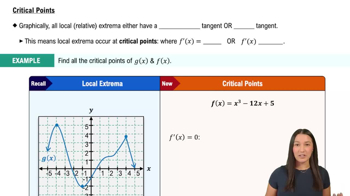
Derivative and Critical Points

The derivative of a function provides information about its rate of change. To find where a function is increasing or decreasing, calculate its derivative and identify critical points where the derivative is zero or undefined. These points are potential locations for local extrema and help determine intervals of increase or decrease.
추천 영상:
04:50
Critical Points

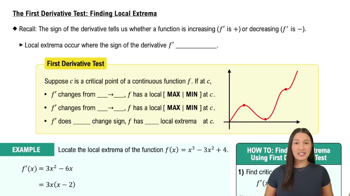
First Derivative Test

The First Derivative Test is used to determine whether a critical point is a local maximum, minimum, or neither. By analyzing the sign of the derivative before and after a critical point, one can ascertain the behavior of the function: if the derivative changes from positive to negative, the point is a local maximum; if it changes from negative to positive, it's a local minimum.
추천 영상:
07:09
The First Derivative Test: Finding Local Extrema

Interval Analysis

Interval analysis involves examining the sign of the derivative over different intervals to determine where the function is increasing or decreasing. By testing points within each interval, one can confirm the behavior of the function, ensuring a comprehensive understanding of its overall shape and identifying any local extrema.
추천 영상:
02:59
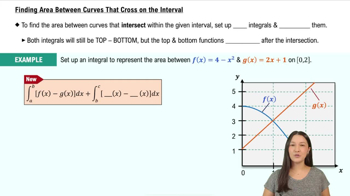
Finding Area Between Curves that Cross on the Interval
관련 실천
교과서 질문

In Exercises 9–66, graph the function using appropriate methods from the graphing procedures presented just before Example 9, identifying the coordinates of any local extreme points and inflection points. Then find coordinates of absolute extreme points, if any.

39. y = 8 / (x² + 4) (Witch of Agnesi)

102
views
교과서 질문

Finding Indefinite Integrals


In Exercises 17–56, find the most general antiderivative or indefinite integral. You may need to try a solution and then adjust your guess. Check your answers by differentiation.


∫(3t² + t/2) dt

29
views
교과서 질문

The intensity of illumination at any point from a light source is proportional to the square of the reciprocal of the distance between the point and the light source. Two lights, one having an intensity eight times that of the other, are 6 m apart. How far from the stronger light is the total illumination least?

250
views
교과서 질문

Initial Value Problems


Solve the initial value problems in Exercises 71–90.


d²y/dx² = 2 − 6x; y′(0) = 4, y(0) = 1

23
views
교과서 질문

Each of Exercises 67–88 gives the first derivative of a continuous function y=f(x). Find y'' and then use Steps 2–4 of the graphing procedure described in this section to sketch the general shape of the graph of f.

80. y' = 1 - cot²θ, for 0 < θ < π

165
views
교과서 질문

Finding Indefinite Integrals


In Exercises 17–56, find the most general antiderivative or indefinite integral. You may need to try a solution and then adjust your guess. Check your answers by differentiation.


∫(1 + cos 4t)/2 dt

21
views