Ch. 4 - Applications of Derivatives
Hass - Thomas' Calculus 15th Edition
Hass15th EditionThomas' CalculusISBN: 9780137616077당신이 사용하는 게 아니라요?교과서 변경
4장, 문제 4.2.15aiii

Roots (Zeros)


a. Plot the zeros of each polynomial on a line together with the zeros of its first derivative.


iii. y = x³ − 3x² + 4 = (x + 1)(x − 2)²

검증된 단계별 안내
1
First, identify the zeros of the polynomial y = x³ − 3x² + 4. To do this, set y equal to zero and solve for x. The polynomial is factored as (x + 1)(x − 2)², so the zeros are x = -1 and x = 2.
Next, find the first derivative of the polynomial y = x³ − 3x² + 4. Use the power rule to differentiate each term: the derivative of x³ is 3x², the derivative of -3x² is -6x, and the derivative of 4 is 0. Therefore, the first derivative is y' = 3x² - 6x.
Set the first derivative equal to zero to find its zeros: 3x² - 6x = 0. Factor out the common term, which is 3x, resulting in 3x(x - 2) = 0. The zeros of the derivative are x = 0 and x = 2.
Plot the zeros of the original polynomial and its derivative on a number line. The zeros of the polynomial are x = -1 and x = 2, and the zeros of the derivative are x = 0 and x = 2. Note that x = 2 is a common zero.
Consider the behavior of the function and its derivative around these zeros. The zero at x = 2 is a repeated zero in the polynomial, indicating a change in concavity or a local extremum. The zero at x = 0 in the derivative suggests a potential inflection point or change in slope.

비슷한 문제에 대한 검증된 영상 답변:

이 영상 해법은 위 문제에 도움이 된다고 튜터들이 추천한 것입니다.
영상 길이:
3m
도움이 되었나요?

주요 개념

질문에 올바르게 답하기 위해 반드시 이해해야 하는 핵심 개념들은 다음과 같습니다.

Roots (Zeros) of a Polynomial

The roots or zeros of a polynomial are the values of x for which the polynomial equals zero. For the polynomial y = (x + 1)(x − 2)², the zeros are x = -1 and x = 2. These points are where the graph of the polynomial intersects the x-axis.
추천 영상:
6:04
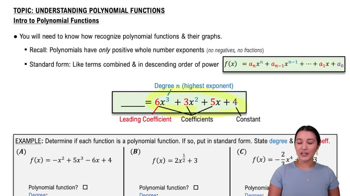
Introduction to Polynomial Functions

First Derivative and Critical Points

The first derivative of a function, denoted as y', represents the rate of change or slope of the function. Finding the zeros of the first derivative helps identify critical points, which are potential locations for local maxima, minima, or points of inflection. For y = x³ − 3x² + 4, the derivative is y' = 3x² - 6x, and its zeros are found by solving 3x(x - 2) = 0, giving x = 0 and x = 2.
추천 영상:
04:50
Critical Points

Graphical Representation of Zeros

Plotting the zeros of a polynomial and its derivative on a number line helps visualize the relationship between the function and its rate of change. The zeros of the polynomial indicate where the graph crosses the x-axis, while the zeros of the derivative indicate where the slope is zero, marking potential turning points or changes in concavity.
추천 영상:
6:37
Zero and Negative Rules