Ch. 7 - Transcendental Functions
Hass - Thomas' Calculus 15th Edition
Hass15th EditionThomas' CalculusISBN: 9780137616077당신이 사용하는 게 아니라요?교과서 변경
7장, 문제 7.3.145a

145. The linearization of eˣ at x = 0
a. Derive the linear approximation eˣ ≈ 1 + x at x = 0.

검증된 단계별 안내
1
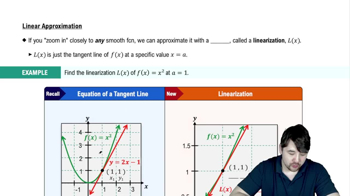
Recall that the linearization (or linear approximation) of a function \( f(x) \) at a point \( a \) is given by the formula: \[ L(x) = f(a) + f'(a)(x - a) \] This represents the equation of the tangent line to the curve at \( x = a \).
Identify the function and the point of linearization: here, \( f(x) = e^x \) and \( a = 0 \).
Calculate \( f(a) = f(0) = e^0 \). Since \( e^0 = 1 \), this gives the value of the function at the point of linearization.
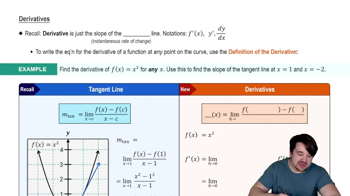
Find the derivative of the function: \( f'(x) = \frac{d}{dx} e^x = e^x \). Then evaluate it at \( x = 0 \), so \( f'(0) = e^0 = 1 \).
Substitute these values into the linearization formula: \[ L(x) = f(0) + f'(0)(x - 0) = 1 + 1 \cdot x = 1 + x \] This is the linear approximation of \( e^x \) near \( x = 0 \).

비슷한 문제에 대한 검증된 영상 답변:

이 영상 해법은 위 문제에 도움이 된다고 튜터들이 추천한 것입니다.
영상 길이:
2m
도움이 되었나요?

주요 개념

질문에 올바르게 답하기 위해 반드시 이해해야 하는 핵심 개념들은 다음과 같습니다.

Linearization of a Function

Linearization approximates a function near a point using the tangent line at that point. It replaces the function with a linear expression that is easier to work with, typically written as L(x) = f(a) + f'(a)(x - a), where a is the point of approximation.
추천 영상:

Derivative of eˣ

The derivative of the exponential function eˣ is eˣ itself. At x = 0, this derivative equals 1, which is essential for finding the slope of the tangent line used in the linear approximation.
추천 영상:

Evaluating Functions and Derivatives at a Point

To find the linear approximation at x = 0, you must evaluate both the function and its derivative at that point. For eˣ, e⁰ = 1 and the derivative at 0 is also 1, leading to the linearization formula eˣ ≈ 1 + x.
추천 영상:
가이드 코스
4:26
Evaluating Composed Functions