Ch. 7 - Transcendental Functions
Hass - Thomas' Calculus 15th Edition
Hass15th EditionThomas' CalculusISBN: 9780137616077당신이 사용하는 게 아니라요?교과서 변경
7장, 문제 7.8.2.a

2. Which of the following functions grow faster than e^x as x→∞? Which grow at the same rate as e^x? Which grow slower?
a. 10x^4 + 30x + 1

검증된 단계별 안내
1
Recall that the function \(e^x\) is an exponential function, which generally grows faster than any polynomial function as \(x \to \infty\).
Identify the given function: \(10x^4 + 30x + 1\), which is a polynomial of degree 4.
Compare the growth rates by considering the limit \(\lim_{x \to \infty} \frac{10x^4 + 30x + 1}{e^x}\).
Since \(e^x\) grows faster than any polynomial, this limit approaches 0, indicating that \(10x^4 + 30x + 1\) grows slower than \(e^x\) as \(x \to \infty\).
Therefore, the function \(10x^4 + 30x + 1\) grows slower than \(e^x\) as \(x\) approaches infinity.

비슷한 문제에 대한 검증된 영상 답변:

이 영상 해법은 위 문제에 도움이 된다고 튜터들이 추천한 것입니다.
영상 길이:
4m

주요 개념

질문에 올바르게 답하기 위해 반드시 이해해야 하는 핵심 개념들은 다음과 같습니다.

Growth Rates of Functions

Growth rates describe how functions behave as the input becomes very large. Comparing growth rates helps determine which functions increase faster, slower, or at the same pace as others, especially as x approaches infinity.
추천 영상:
가이드 코스
04:16
Intro To Related Rates

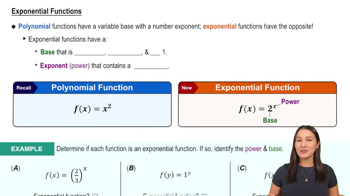
Exponential Functions

Exponential functions like e^x grow by continuously multiplying by a constant base raised to the variable power. They increase faster than any polynomial function as x approaches infinity, making them a benchmark for comparing growth rates.
추천 영상:
6:13
Exponential Functions

Polynomial Functions

Polynomial functions are sums of terms with variables raised to whole number powers, such as 10x^4 + 30x + 1. Their growth rate is dominated by the highest power term and is slower than exponential functions as x approaches infinity.
추천 영상:
07:00
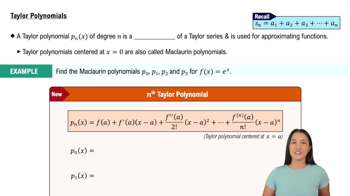
Taylor Polynomials