Ch. 7 - Transcendental Functions
Hass - Thomas' Calculus 15th Edition
Hass15th EditionThomas' CalculusISBN: 9780137616077당신이 사용하는 게 아니라요?교과서 변경
7장, 문제 7.5.80c

80. Find all values of c that satisfy the conclusion of Cauchy's Mean Value Theorem for the given functions and interval.
c. f(x) = x³/ (3 - 4x), g(x) = x², (a, b) = (0, 3)

검증된 단계별 안내
1
Recall Cauchy's Mean Value Theorem (CMVT): If functions \(f\) and \(g\) are continuous on \([a,b]\) and differentiable on \((a,b)\), and \(g'(x) \neq 0\) on \((a,b)\), then there exists at least one \(c \in (a,b)\) such that \[\frac{f'(c)}{g'(c)} = \frac{f(b) - f(a)}{g(b) - g(a)}.\]
Verify that \(f(x) = \frac{x^3}{3 - 4x}\) and \(g(x) = x^2\) are continuous on \([0,3]\) and differentiable on \((0,3)\). Note any points where the denominator \(3 - 4x\) might be zero and exclude those if necessary.
Calculate the values \(f(a)\), \(f(b)\), \(g(a)\), and \(g(b)\) for \(a=0\) and \(b=3\): \[f(0) = \frac{0^3}{3 - 4 \cdot 0} = 0,\] \[f(3) = \frac{3^3}{3 - 4 \cdot 3} = \frac{27}{3 - 12} = \frac{27}{-9},\] \[g(0) = 0^2 = 0,\] \[g(3) = 3^2 = 9.\]
Find the derivatives \(f'(x)\) and \(g'(x)\): For \(f(x) = \frac{x^3}{3 - 4x}\), use the quotient rule: \[f'(x) = \frac{(3x^2)(3 - 4x) - x^3(-4)}{(3 - 4x)^2} = \frac{3x^2(3 - 4x) + 4x^3}{(3 - 4x)^2}.\] For \(g(x) = x^2\), the derivative is: \[g'(x) = 2x.\]
Set up the equation from CMVT: \[\frac{f'(c)}{g'(c)} = \frac{f(3) - f(0)}{g(3) - g(0)} = \frac{\frac{27}{-9} - 0}{9 - 0} = \frac{-3}{9} = -\frac{1}{3}.\] Substitute the derivatives: \[\frac{\frac{3c^2(3 - 4c) + 4c^3}{(3 - 4c)^2}}{2c} = -\frac{1}{3}.\] Simplify and solve this equation for \(c\) in the interval \((0,3)\), excluding any points where the denominator is zero.

비슷한 문제에 대한 검증된 영상 답변:

이 영상 해법은 위 문제에 도움이 된다고 튜터들이 추천한 것입니다.
영상 길이:
10m
도움이 되었나요?

주요 개념

질문에 올바르게 답하기 위해 반드시 이해해야 하는 핵심 개념들은 다음과 같습니다.

Cauchy's Mean Value Theorem

Cauchy's Mean Value Theorem generalizes the Mean Value Theorem by relating two functions. It states that if functions f and g are continuous on [a, b] and differentiable on (a, b), and g'(x) ≠ 0 on (a, b), then there exists at least one c in (a, b) such that (f(b)-f(a))/(g(b)-g(a)) = f'(c)/g'(c).
추천 영상:
가이드 코스
06:11
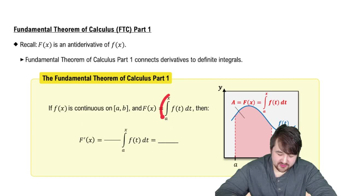
Fundamental Theorem of Calculus Part 1

Differentiability and Continuity of Functions

To apply Cauchy's Mean Value Theorem, both functions must be continuous on the closed interval and differentiable on the open interval. This ensures the existence of derivatives and the validity of the theorem. Checking these conditions for f(x) = x³/(3 - 4x) and g(x) = x² on (0, 3) is essential.
추천 영상:
05:34
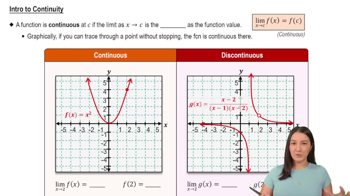
Intro to Continuity

Finding and Solving for c

After confirming the theorem's conditions, compute f'(x) and g'(x), then set the ratio of their differences equal to the ratio of their derivatives at c. This leads to an equation in c, which must be solved within the interval (0, 3) to find all valid values satisfying the theorem.
추천 영상:
06:06
Solving Separable Differential Equations